

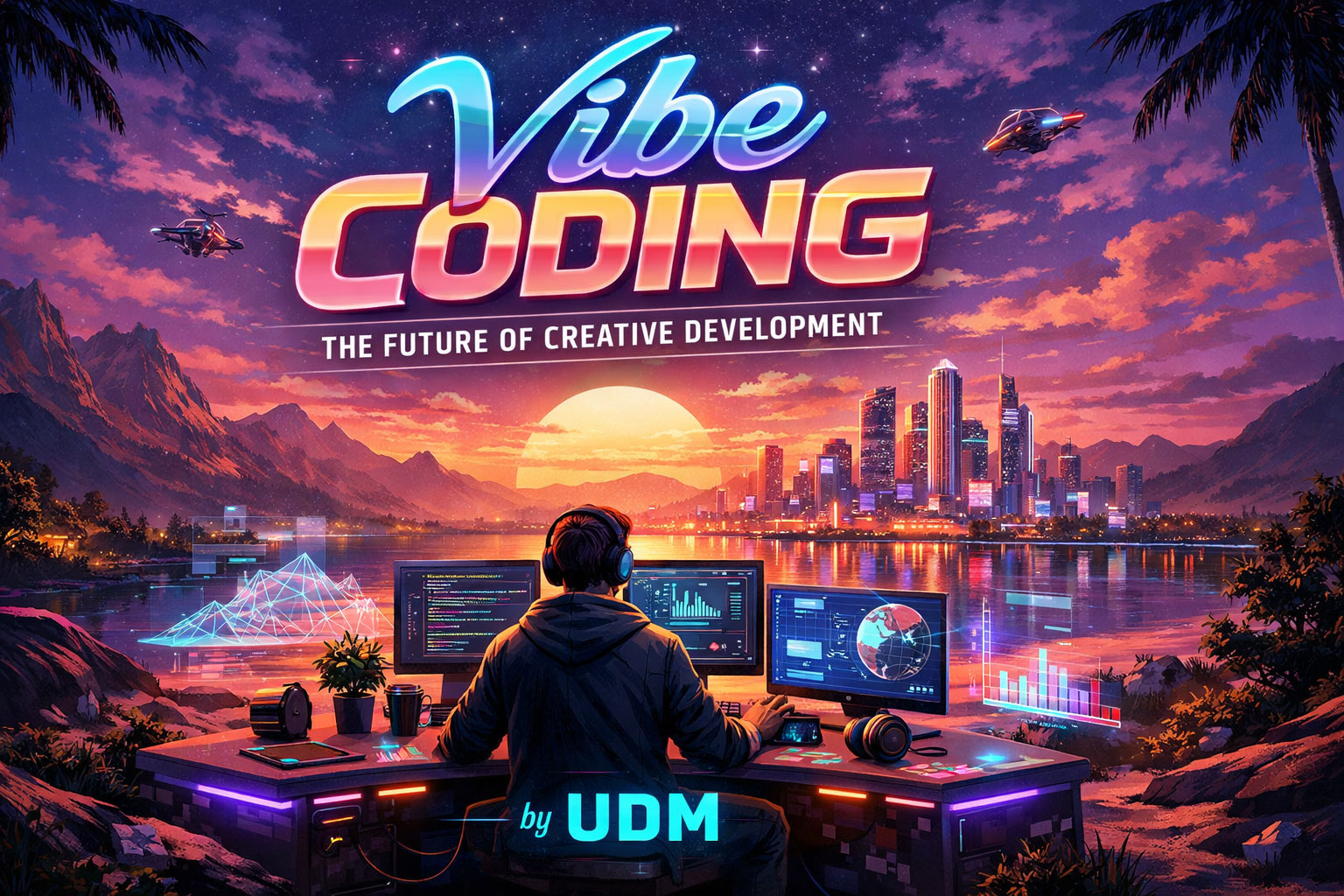
Vibe Coding: The Future of Creative Development by UDM
In the rapidly evolving landscape of technology, vibe coding a seismic shift is occurring in how we interact with machines. This revolutionary approach allows creators to build functional software by simply describing their vision in natural language. As a result, the barrier to entry for software engineering is dissolving, shifting the focus from manual typing to high-level conceptual architecture.
Furthermore, vibe coding isn’t just a trend for hobbyists. Professional developers are increasingly adopting these AI-driven workflows to eliminate the “grunt work” of boilerplate code. Consequently, teams can now manifest complex applications at the speed of thought. In addition to increasing speed, this methodology fosters a more creative environment where the “vibe”—the intent and user experience—takes center stage over semicolon placement.
Ultimately, understanding this shift is crucial for anyone in the digital space. Whether you are a seasoned engineer or a non-technical founder, vibe coding offers a glimpse into a future where human intuition is the most powerful programming language available. Therefore, it is time to stop worrying about the syntax and start focusing on the vision.
The Philosophy of Intent-Based Development
To truly grasp the impact of this movement, we must first understand the philosophical shift from “how” to “what.” Historically, programming has been an exercise in translation. A developer would have a vision and then spend hours translating that vision into a language the computer could understand. However, vibe coding flips this script entirely.
As a result, the cognitive load shifts from syntax to architecture. Furthermore, this approach treats AI not as a simple autocomplete tool, but as an expert collaborator that understands context. Consequently, the developer acts more like a creative director, guiding the AI through iterations until the output matches the internal vision.
The Technical Architecture Behind the Vibe
While the term might sound casual, the underlying technology is incredibly sophisticated. In order to make vibe coding possible, Large Language Models (LLMs) must process vast amounts of semantic data. They don’t just look for keywords; they analyze the structural relationships between different code modules. Therefore, when you describe a feature, the AI is able to map that description to existing design patterns and best practices.
Moreover, the integration of real-time compilers and instant feedback loops is essential to this workflow. Because the AI can generate and run code in a sandboxed environment, the user can see the results of their “vibe” immediately. If the result isn’t quite right, the user provides natural language feedback—a process often called “vibing the code”—until the desired state is reached. In addition to this, modern IDEs are being rebuilt from the ground up to support this fluid, conversational style of creation.
Bridging the Gap Between Design and Deployment
One of the most significant advantages of this methodology is the way it collapses the traditional software development lifecycle. However, with vibe coding, these roles begin to merge. Since the AI can interpret visual descriptions and functional requirements simultaneously, the journey from concept to deployment is drastically shortened.
By extension, this democratization of development means that founders and visionaries can prototype ideas in hours rather than weeks. Nevertheless, this doesn’t render traditional coding skills obsolete. Instead, it elevates the role of the senior engineer. While the AI handles the boilerplate and basic logic, the human expert is responsible for security audits, complex integrations, and ensuring the “vibe” scales effectively across a global infrastructure.
The Evolution of Natural Language Processing in Tech
To understand why this is happening now, we must look at the maturity of Natural Language Processing (NLP). Only recently have models become “reasoning” engines rather than just “prediction” engines. Consequently, they can now handle the ambiguity of human speech. For example, if a user says, “Make the login screen feel more secure,” the AI understands the need for two-factor authentication prompts or specific encryption icons without being told the exact lines of code to write.
Furthermore, the feedback loop in vibe coding is uniquely non-linear. In traditional coding, a single missing semicolon can break a project. In contrast, vibe coding is resilient. Thus, the development process becomes a dialogue, reducing the frustration and “bottlenecking” that often occurs in traditional software sprints.
Impact on the Global Digital Economy
The economic implications of this shift are massive, particularly for digital agencies and SEO professionals. Because the speed of execution is increasing, the cost of building custom tools is plummeting. As a consequence, businesses can now afford to build bespoke internal software that was previously too expensive to justify. Additionally, this allows for a more agile approach to marketing; if a new trend emerges, a developer can “vibe” a landing page or a micro-tool into existence by the end of the day.
Moreover, we are seeing a rise in “Vibe-First” startups. These are companies built by small teams who use AI to punch way above their weight class. By utilizing these tools, a two-person team can maintain a codebase that would have required twenty people just five years ago. However, this also means the market will become more competitive. Therefore, the real winners in the 2026 economy will be those who can articulate their vision most clearly, rather than those who can simply type the fastest.
Technical Literacy in the Age of AI
A common misconception is that vibe coding is “no-code.” On the contrary, it is “all-code,” but the code is managed through a higher-level abstraction. To be successful in this new era, one must still understand how software works. Even though you aren’t writing every line, you need to understand data structures, API calls, and user flow to give the AI the right “vibe.”
Essentially, technical literacy is evolving into “prompt literacy.” In the same way that a master photographer knows how to manipulate light even if they use a digital camera, a master vibe coder knows how to manipulate logic through language. Ultimately, this empowers a new generation of creators who were previously sidelined by the steep learning curve of traditional programming languages like C++ or Java.
Scaling and Maintainability of Vibe-Generated Code
One of the primary concerns among skeptics is whether code generated through “vibes” can truly scale. Admittedly, early iterations of AI code were often messy or redundant.As a result, the code produced is often cleaner and more standardized than what an average human might write under a tight deadline.
Furthermore, maintaining this code becomes easier because the AI can act as the “living documentation.” If a new developer joins a project, they don’t have to spend days reading through thousands of lines of legacy code. Instead, they can ask the AI to explain the “vibe” of a specific module.
Frequently Asked Questions
1. Is vibe coding the same as no-code or low-code platforms? Not exactly. As we have explored, the technical barriers that once stood in the way of great ideas are rapidly falling.
2. Will vibe coding replace professional software engineers? On the contrary, it is more likely to evolve their role.As a result, engineers become high-level architects who can deliver projects significantly faster than ever before.
3. Do I need to know any programming languages to start? While a basic understanding of logic is helpful, you do not need to be fluent in specific languages like Python or JavaScript to begin. Because the system interprets your natural language instructions, you can focus on the functional requirements.
Conclusion
In summary, the rise of vibe coding represents a definitive turning point in the history of technology. By shifting the focus from the rigid constraints of machine language to the fluid nature of human expression, we are unlocking a massive wave of innovation. you are an entrepreneur looking to launch a startup or a seasoned developer aiming to optimize your workflow, this methodology offers an unprecedented level of creative freedom. As we have explored, the technical barriers that once stood in the way of great ideas are rapidly falling. Consequently, the future of software development is no longer just about writing lines of code; it is about mastering the “vibe” and bringing visionary concepts to life with a single prompt. Therefore, now is the perfect time to embrace this change and lead the charge into a more intuitive digital world.
If you want to get Our Services, visit our Contact Us page or message us directly on WhatsApp.
Because we believe in continuous growth, we have curated a selection of posts to help you master the digital world. Furthermore, visiting our Blog Page regularly will keep you updated on the latest industry shifts.


