


Why Global Businesses Hire a Web Development Company in Pakistan
Engineering leaders and founders usually arrive at the same crossroad: local engineering salaries in the US or Western Europe are eating up runway, but cheap freelance marketplaces deliver spaghetti code that has to be rewritten six months later.
Pakistan has quietly become the middle ground where businesses solve this dilemma. Partnering with a vetted web development company in Pakistan: custom websites & web apps that scale no longer means compromising on architectural integrity to protect your budget.
| Hiring Model | Typical Hourly Rate | Code Quality & Longevity | Communication Overhead |
|---|---|---|---|
| US/UK Local Agency | $120 – $220+ | High (architecturally sound) | Low (real-time, native) |
| Random Freelancer | $15 – $30 | Unpredictable (high tech debt) | High (chasing updates) |
| Established Pakistani Agency | $35 – $65 | High (enterprise frameworks) | Low to Medium (managed workflows) |
A few structural realities drive this shift:
Real cost-to-value efficiency:
You aren’t buying bottom-barrel labor; you are hiring senior full-stack engineers at 60–70% lower burn rates than domestic equivalents. That margin lets startups build out an entire sprint team for the price of a single onshore developer.
Trained, English-fluent engineers:
The core technical workforce comes straight out of competitive computer science programs like NUST, FAST-NUCES, and LUMS. These teams run on standard stacks (Node, Python, React, AWS) and write clean, maintainable documentation without language friction.
Time zone integration that works:
For teams in the UK, Central Europe, and the GCC, working hours naturally overlap by 4 to 6 hours daily. For North American teams, established agencies routinely run afternoon-to-midnight shifts to guarantee shared standups and fast Slack turnarounds.
Institutional backing:
The Pakistan Software Export Board (PSEB) has spent years cleaning up the operational side, standardizing IP protections, and making cross-border payments straightforward under international business laws.
Here is what most guides gloss over: hiring in Pakistan fails if you treat it as a hands-off, “throw tickets over the wall” arrangement. Success depends on selecting an agency that operates as a product partner, running structured CI/CD pipelines rather than just delivering raw code.

Below, we break down how to separate junior dev shops from top-tier engineering teams, what tech stacks fit your goals, and how to protect your IP from day one.
Core Services to Expect: Custom Websites vs. Complex Web Apps
A marketing site that loads fast is not the same beast as a multi-tenant SaaS platform handling thousands of concurrent checkouts. When hiring a web development company in Pakistan: custom websites & web apps both fall under their pitch decks, but building them demands entirely different engineering mindsets.
Choosing the wrong architecture early on leads directly to costly rebuilds.
| Build Type | Typical Architecture | Dominant Tech Stack in Pakistan | Primary Bottleneck |
|---|---|---|---|
| Brand Site | Headless CMS / SSG | Next.js, Vue, Strapi, WordPress Engine | Core Web Vitals, CDN caching |
| Web App / SaaS | Microservices, Event-Driven | Node.js, Laravel, Django, .NET Core | Concurrency, DB connection pooling |
For brand portals, top Pakistani engineering teams rarely ship monolithic WordPress builds anymore. Instead, they decouple the front end using Next.js or Vue backed by a headless CMS. This approach guarantees sub-second page loads and locks down security because there is no direct database access on the client side.
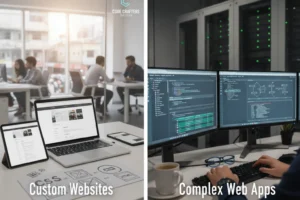
Once you cross into custom web applications, logic shifts toward state management, isolated workloads, and high data throughput. Local teams lean heavily on battle-tested frameworks:
Backend heavy-hitters:
Laravel remains a dominant, cost-effective choice for rapid CRUD builds and fintech MVPs. For distributed, CPU-bound workloads, teams shift toward Python/Django, Node.js, or .NET Core.
Data layer resilience:
Production setups pair PostgreSQL for strict ACID compliance with Redis clusters to handle session caching and rate-limiting. Document stores like MongoDB are reserved for unstructured data, rather than forced into relational models.
Integrations:
Beyond writing clean RESTful and GraphQL endpoints, local developers specialize in bridge engineering. That means wiring enterprise ERPs, HubSpot, and bespoke LLM APIs alongside localized payment failovers (such as integrating 2Checkout, Payoneer, or local escrow gateways where native Stripe isn’t supported).
If an agency claims a standard CMS build can double as an enterprise portal simply by bolting on plugins, walk away. True scale requires decoupled infrastructure from day one.
Proven Case Studies: Real-World Solutions Built by Pakistani Engineers
Evaluating a web development company in Pakistan: custom websites & web apps that scale requires moving past portfolio screenshots. You want to see how engineering teams solve high-stakes architecture problems under real production stress.
Here is how top-tier teams in tech hubs like Lahore and Karachi routinely deliver complex systems:
- FinTech Core Engine (UK Client): A Lahore engineering team built a dual-entry, real-time ledger alongside an FCA-compliant API integration for a London-based cross-border payments firm. Instead of relying on off-the-shelf wrappers, they used Go and PostgreSQL with strict pessimistic locking to eliminate race conditions during peak settlement windows.
- Enterprise E-commerce (GCC Retailer): Facing massive checkout drops during flash sales, a Gulf retail group partnered with a Pakistani agency to decouple their monolithic setup. The team built a headless Shopify storefront backed by a custom Node.js and Redis middleware layer, smoothly sustaining over 50,000 daily transactions without catalog latency.
- HIPAA-Compliant HealthTech (US Startup): For an urgent care SaaS, an Islamabad team engineered end-to-end encrypted telemedicine rooms using WebRTC, backed by AWS HIPAA-eligible infrastructure. They chose self-hosted STUN/TURN relays over third-party APIs to keep streaming costs predictable as patient volume tripled.
Architecture and Impact Summary
| Project Scope | Core Tech Stack | Production Challenge Solved | Key Outcome |
|---|---|---|---|
| Cross-Border Ledger | Go, PostgreSQL, AWS | Race conditions & ledger reconciliation | Sub-second settlement, audit-ready |
| Headless E-commerce | Node.js, Redis, Shopify Plus | Database locking at 50k+ daily orders | 99.98% uptime, zero checkout lag |
| Telemedicine SaaS | React, Node.js, WebRTC, AWS | HIPAA data security & WebRTC jitter | 70ms median latency, fully compliant |
When you audit these projects, ignore vanity metrics. Ask your prospective team for their code-level baselines:
Look for maintainable delivery standards, specifically automated test coverage above 80% on business-critical logic, stable sprint velocity that doesn’t collapse during bug fixes, and Google Core Web Vitals hitting green across real user monitoring (RUM), not just staging environments. If an agency cannot explain their trade-offs—like when they chose server-side rendering over client-side hydration to protect initial load times—keep looking.
Critical Mistakes to Avoid When Outsourcing Web Development to Pakistan
Outsourcing offshore offers huge cost efficiencies, but missteps early on can quietly wreck your product roadmap. When hiring a web development company in Pakistan: custom websites & web apps require strict technical vetting and real oversight, not just blind trust in an attractive proposal.
Here are the operational traps that burn product founders most often:
Hiring anonymous freelancers over registered agencies:
An unvetted Upwork profile might save you 30% upfront, but solo contractors rarely come with QA engineers, backup talent, or mature CI/CD pipelines. If they fall ill, your sprint halts.
Leaving IP ownership ambiguous:
Never write a line of code without an enforceable NDA and an explicit “work-made-for-hire” assignment. If your contract doesn’t explicitly anchor intellectual property transfer to milestones under clear jurisdiction, you risk your equity during future investor due diligence.
Chasing the bargain-basement quote:
Pakistan’s senior engineering talent is world-class, but elite devs don’t charge $8 an hour. Rock-bottom bids almost always yield tightly coupled spaghetti code, hardcoded credentials, and zero automated testing. You end up paying twice: once to build it, and double to rewrite it.
Tolerating vague communication habits:
If an agency suggests managing a complex web app through fragmented WhatsApp voice notes instead of Jira, linear roadmaps, and documented PR reviews, walk away.
The differences between an amateur setup and a production-grade agency usually show up in how they handle delivery mechanics:
| Vetting Factor | High-Risk Approach | Production-Ready Agency |
|---|---|---|
| Legal & IP | Unsigned terms; ambiguous local contracts | Enforceable international IP transfer pre-sprint |
| Architecture | Direct-to-main pushes; zero test coverage | Gitflow, Dockerized staging, automated CI/CD |
| Project Cadence | Ad-hoc messages, reactive progress updates | Daily async standups, sprint demos, shared Jira |
Without an Agile framework running on Slack and Jira, the time difference works against you instead of functioning as a round-the-clock development cycle. Treat your offshore team like an internal engineering unit, enforce strict standards from day one, and you avoid the typical post-launch rewrite.
Vetted Standards and E-E-A-T Verification for Pakistani Tech Firms
Hiring across borders gets risky when vetting stops at a polished slide deck. Plenty of shops claim enterprise chops, but separating an established partner from an unstable outfit takes real due diligence. If you want to hire a dependable web development company in Pakistan: custom websites & web apps that hold up under scale require hard proof of legitimacy, security maturity, and engineering hygiene.

Start with corporate records. Fly-by-night operators avoid legal overhead, so check local regulatory standing before reviewing code:
- SECP Incorporation: Confirms legal business existence in Pakistan, corporate structure, and accountability.
- PSEB Registration & P@SHA Membership: Validates the firm as an active IT exporter aligned with national industry standards and local tech councils.
Paperwork alone won’t build software. You need to inspect their day-to-day engineering discipline. Ask for sanitized, production-style pull requests or public GitHub profiles. If a team rarely merges code, lacks unit tests, or relies on manual FTP uploads, walk away. Modern delivery requires automated CI/CD pipelines deploying directly into AWS, Google Cloud, or Azure environments.
Here is how to run a quick technical reality check:
| Evaluation Layer | Weak Signal (Red Flag) | Strong Signal (E-E-A-T Verified) |
|---|---|---|
| Code Hygiene | Zero public repos; manual SSH/server patches | Active GitHub org; tagged releases; documented CI/CD scripts |
| Client Feedback | Unverifiable testimonials on personal landing pages | Clutch/GoodFirms reviews tied to verified client LinkedIn profiles |
| Data Governance | Blank stares when asked about regional privacy rules | Documented compliance roadmaps for GDPR, SOC 2, or ISO 27001 |
Skip agencies that treat compliance as an afterthought. If your web app processes European user data or handles sensitive enterprise workloads, the engineering team must understand GDPR data minimization and role-based access control from sprint zero. Verifying these standards early ensures your offshore engagement builds durable software rather than expensive technical debt.
Frequently Asked Questions About Building Custom Web Apps in Pakistan

What are the realistic rates for mid-to-senior talent?
Pricing in Pakistan gives you deep technical mileage, but rock-bottom rates usually mean technical debt. Expect clear tiers based on seniority rather than vague “one-size-fits-all” quotes.
| Experience Level | Hourly Rate (USD) | Best Suited For |
|---|---|---|
| Mid-Level Engineer | $18 – $30 | Feature builds, standard APIs, modular refactoring |
| Senior / Lead Architect | $35 – $55+ | Distributed systems, cloud infra, complex schemas |
For fixed-price contracts, legitimate teams rarely quote without an initial discovery sprint. Beware of shops quoting complex MVPs under $5,000; they often skip automated testing and edge-case handling.
How do teams navigate international invoicing?
Since Stripe doesn’t operate direct merchant accounts locally, experienced shops don’t rely on messy workarounds. Established agencies routinely invoice through foreign-registered entities (often LLCs in Delaware or the UK) or use platforms like Payoneer, Wise Business, and direct SWIFT wires into local foreign-currency bank accounts. Always insist on milestone-based escrow or net-15 payment terms tied to Git pull requests, rather than paying large upfront sums.
How is project transparency managed across time zones?
When hiring a web development company in Pakistan: custom websites & web apps require tight alignment, especially if you sit in North America or Europe. Top-tier teams run standard two-week Agile sprints using a familiar stack:
- Async tracking: Jira, Linear, or ClickUp boards mapped to acceptance criteria.
- Daily rituals: 15-minute Slack standups overlapping with your morning.
- Code governance: Direct access to GitHub or GitLab repos with automated CI/CD previews.
What happens after launch when something breaks?
Never close a project without a signed Service Level Agreement (SLA). Reliable agencies categorize bugs by severity:
- Critical (P1): Payment flow down or database unreachable; targeted response within 1 to 2 hours.
- Non-critical (P3): Styling defects or edge-case script bugs; bundled into scheduled monthly maintenance windows.
A common pitfall is treating post-launch support as an afterthought. Retain your core engineers on a baseline 10–20 hour monthly retainer to keep runtime dependencies patched and server logs clean.
Step-by-Step Decision Framework for Selecting Your Development Partner
Hiring overseas often feels like a gamble, but it doesn’t have to be. If you want to hire a web development company in Pakistan: custom websites & web apps that actually scale, you need a vetting process that tests technical grit before you hand over a deposit.
Phase 1: Lock Down the Spec Before Reaching Out
Don’t send out vague briefs. Write an airtight Scope of Work (SOW) and Product Requirements Document (PRD). Define user roles, database relationships, and third-party API dependencies. If an agency gives you an estimate without asking how you handle authentication edge cases or background job queues, walk away. They are selling hours, not architecture.
Phase 2: Grill the Actual Lead Architect
Skip the polished sales reps. Get the technical lead on a call and dig into system design:
- Ask how they would handle cache invalidation on a high-traffic e-commerce checkout.
- Have them explain a past architectural failure and how they patched it.
- Check English fluency during spontaneous problem-solving, not rehearsed slide decks.
Phase 3: Run a Paid Discovery Sprint
Never sign a six-month contract cold. Pay the agency for a two-week proof-of-concept (POC) or architectural spike. This small investment reveals their real velocity, GitHub PR hygiene, and how they handle communication across time zones.
| Engagement Phase | What You Test | Green Flag | Red Flag |
|---|---|---|---|
| Paid POC (1–2 Wks) | Code quality & daily standups | Clean commits, documented APIs | Silent gaps, missed deadlines |
| Full Build | Milestone delivery | Code shipped to staging weekly | “Almost done” updates with no demo |
Final Step: Milestone-Based Contracts
Once the squad proves their capability, tie your contract to tangible deliverables, not billable hours. Structure payments around working features deployed to a staging server. A standard setup is 30% upfront, 40% tied to mid-project functional milestones, and 30% after UAT and codebase handover. This keeps incentives aligned from day one.
Ready to create the Custom Website or App? visit our Contact page or contact us on Whatsapp.

