

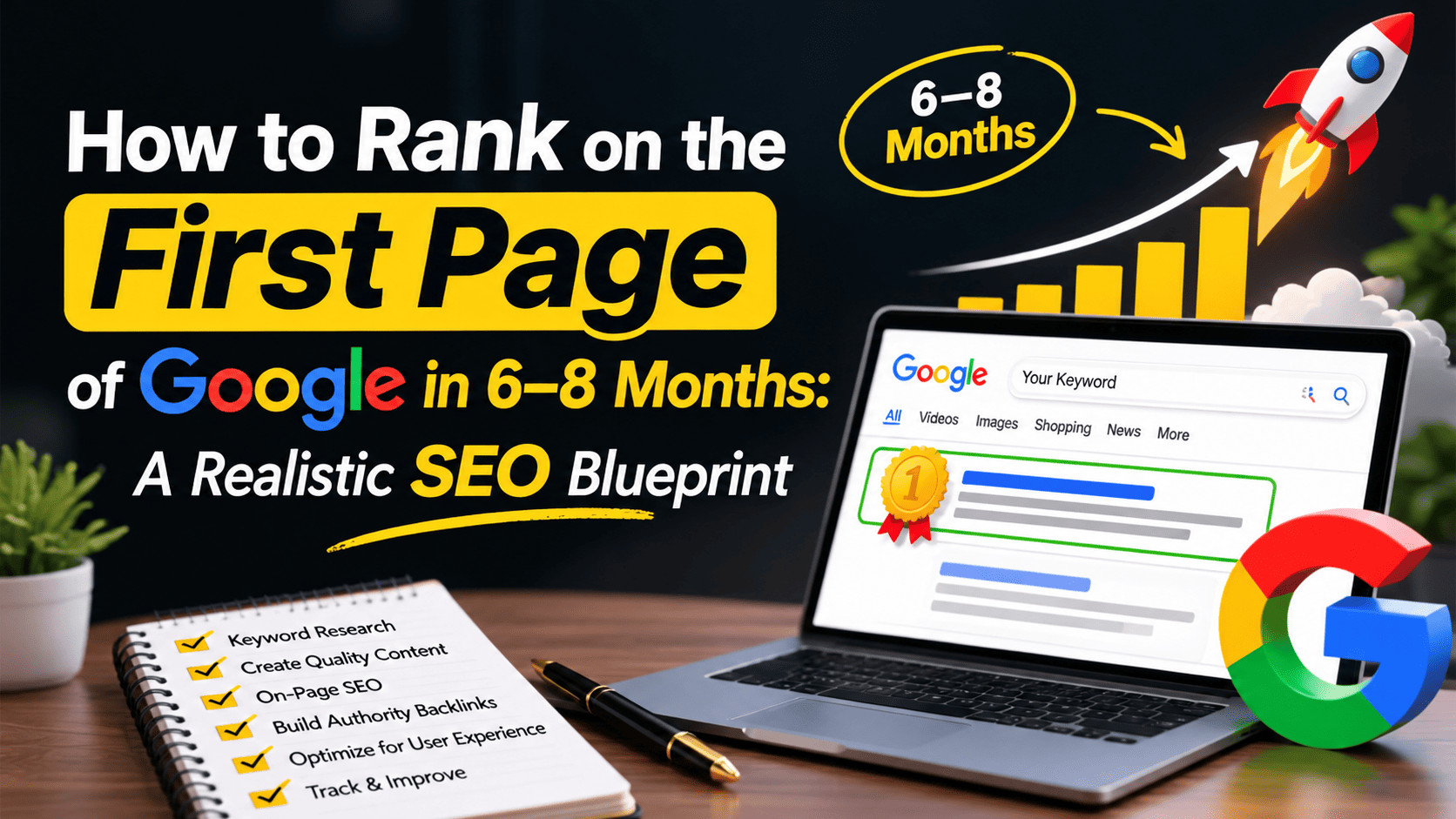
Why 6–8 Months Is the Realistic Timeline to Rank on Google
Anyone promising you can rank on page one of Google in thirty days is either selling snake oil or targeting zero-volume keywords nobody searches for. In the real world, sustainable organic growth is governed by search engine crawl budgets, link discovery cycles, and algorithmic trust tests. If you want to rank on the first page of Google for terms that actually drive pipeline, six to eight months is the baseline window you need to plan around.
Google doesn’t evaluate content in a vacuum anymore. Between the Helpful Content System and regular core updates, the algorithm wants to see sustained topical authority before it hands over premium real estate. A brand-new URL might get indexed by Tuesday, but the system watches user interaction signals, waits for inbound links to be re-crawled, and tests your page in lower SERP positions long before it risks showing you in the top five.
Where you land within that timeline depends heavily on your starting line:
| Asset Status | Technical Health | Link Profile | Expected Timeframe |
|---|---|---|---|
| Aged Domain (2+ yrs) | Clean architecture, no crawl errors | Established, natural backlink base | Closer to 5–6 months |
| Fresh Domain (0–6 mos) | Unproven crawl history, clean tech | Zero external trust, sandbox phase | Full 8+ months |
If your technical foundation is broken, publishing thirty articles a month won’t save you. Conversely, pumping out generic pieces without building topical depth just earns you a spot in the omitted results.
Here is what honest progress actually looks like over these two quarters:
- Months 1–2: Crawl patterns stabilize, core pages get indexed, and Search Console starts reporting long-tail impressions with negligible clicks.
- Months 3–4: Low-competition variants climb to pages two and three as internal links pass initial equity.
- Months 5–8: Compounding topical authority kicks in, lifting primary target queries onto page one.
Next, let’s audit your foundation so you don’t waste the first two months building on quicksand.
How to Choose Keywords You Can Actually Win Within 240 Days
If you want to rank on the first page of Google inside an eight-month window, you cannot rely on keyword volume alone. Chasing broad head terms like “project management software” is suicide for a fresh push; enterprise giants and review aggregators own those spots permanently.
Instead, look for cracked SERPs. When you inspect the top five results for a query, you want to spot at least one or two pages with a Domain Rating (DR) under 35, forums like Reddit, or outdated thin posts. That is your proof of concept.
| Target Type | SERP Profile (Positions 1–5) | 240-Day Viability |
|---|---|---|
| Aggregator-Heavy | G2, Forbes, Capterra, Amazon | Avoid (0–5% win rate) |
| Cracked Mid-Tier | Niche blogs, low-DR sites, Reddit threads | Target (High win rate) |
Once you identify these gaps, stop treating them as isolated, one-off blog targets. A single post rarely builds enough contextual weight to crack page one anymore. Group your keywords into tight topical clusters. If you are targeting a mid-tier commercial query like “hip roof framing calculator,” you also need supporting informational pieces covering pitch calculations, rafter spacing, and common framing errors that link back to the main tool.

By month three, your manual research takes a backseat to real user data. Open Google Search Console, set the date filter to the last 28 days, and filter queries by average position:
- Identify queries sitting between positions 11 and 25 (your striking-distance keywords).
- Look for phrases your page ranks for that you never explicitly wrote into the copy.
- Update the existing post to answer those specific queries with dedicated subheadings and custom tables.
Optimizing for queries where Google already tests your content yields first-page wins months faster than publishing brand-new URLs from scratch.
Building Content That Satisfies Modern Search Intent and Helpful Content Guidelines
If you want to rank on the first page of Google within an eight-month window, repeating what the top five results already say won’t cut it. Google’s Helpful Content system explicitly demotes derivative write-ups. You need what patent filings call information gain—novel perspectives, proprietary numbers, or actual hands-on verification that doesn’t exist elsewhere on the web.
Start with an information-gain audit before drafting a single sentence. Open the current top 10 URLs for your target term, pull out their main arguments, and look for the blind spots.
| Content Strategy | What It Looks Like | Search Impact |
|---|---|---|
| Echo Chamber (Old SEO) | Summarizing SERP rivals with slightly better formatting. | Risks getting filtered out as low-gain fluff. |
| Information Gain (Modern SEO) | Adding internal test benchmarks, edge cases, and contrarian takeaways. | Wins citations, earns AI Overview inclusion, stabilizes rankings. |
Once you have your unique angle, structure the page so readers (and LLM crawlers) get immediate answers. Write a 40-to-50-word direct-definition block right under your first H2, before elaborating. Skip the slow narrative warm-ups; front-load the conclusion.

From there, organize with a tight H2/H3 hierarchy that weaves in related entities naturally. If your page covers technical audits, search engines expect to see related concepts like crawl budgets, log files, and canonical tags—not because you’re stuffing keywords, but because you can’t solve the user’s problem thoroughly without them.
Finally, anchor the piece with unassailable E-E-A-T signals:
- First-person validation: Document real wins and failures (“In month three, our organic traffic dipped 12% after restructuring directories, here’s why…”).
- Identifiable author footprints: Link author bios to real professional work, clear editorial review processes, and verified niche credentials.
- Transparent trade-offs: Tell readers when a tactic won’t work. Admitting that programmatic SEO fails for low-search-volume B2B niches, for instance, proves you actually practice what you preach.
Proven Case Studies: Real Websites That Reached Page One in Under Eight Months
Theory is cheap in search marketing. To actually rank on the first page of Google inside an eight-month window, you need proof of execution under current algorithm conditions. Here is how two distinct properties pulled it off recently without burning cash on toxic link packages.
| Project Profile | Core Strategy | Velocity | Month 7 Outcome |
|---|---|---|---|
| B2B Workflow SaaS (DR 28) | Topical authority clusters around workflow bottlenecks | 4 articles/week | 5 primary product terms in top 5 |
| Specialty Home Goods Affiliate (DR 12) | Programmatic vs. pages + long-tail teardowns | 6 articles/week | 45k monthly organic sessions |
The B2B Play: Topical Dominance Over High-Volume Bait
This team avoided broad industry keywords early on. Instead, they mapped every sub-problem their software solved, producing 24 tightly related articles around single pain points.
Once Google viewed the domain as an authority on those micro-problems, we rewired the internal linking. We pointed contextual links from these high-performing informational posts directly to five bottom-funnel product landing pages using exact- and partial-match anchors. That single internal architecture shift shoved those transactional URLs from stagnant positions on page two (spots 14–18) right into the top three.

The Affiliate Turnaround: Programmatic Comparison Clusters
The affiliate site started from scratch. Rather than chasing generic “best espresso machine” queries, the publisher rolled out templated comparison pages (Brand A vs. Brand B) alongside deep-dive product reviews.
The mechanics that made both setups work boiled down to two non-negotiables:
- Sustained crawl budget: Publishing 4–6 tight, well-edited pieces weekly forced Googlebot to recrawl the site daily, shrinking the index-to-rank lag from weeks to roughly 48 hours.
- Aggressive internal PR distribution: Every fresh piece immediately linked out to an underperforming target page, bypassing the need for immediate external backlinks.
If you publish two posts a month and ignore contextual links, an eight-month timeline simply will not happen. Consistency creates the momentum Google rewards.
Search Engine Guidelines and Industry Research on Ranking Speeds
Google’s public stance has always been consistent: there is no artificial “sandbox” holding back young domains. Search Central documentation points instead to crawl budgets, technical rendering, and the natural lag in evaluating site-level quality signals. Google wants to see a predictable track record of helpfulness before it risks serving your content to millions.
Independent data backs up why patience is non-negotiable. A classic Ahrefs study tracking two million newly published pages revealed that a mere 5.7% managed to rank on the first page of Google within a year. Those rare outliers didn’t just get lucky; they concentrated on low-competition keyword clusters backed by rapid, contextual link velocity.

| Ranking Dynamic | What the Data Shows | Practical Reality for New Pages |
|---|---|---|
| Ahrefs Page-One Velocity | ~94.3% fail to hit page one within 12 months. | High-volume head terms take a full year; long-tail variants carry early traffic. |
| SparkToro Zero-Click Trend | Over 50% of searches end without a website click. | Featured snippets and direct answers soak up casual queries; intent must be transactional or deep. |
| Backlinko Position Data | The #1 organic result captures roughly 27.6% of clicks. | Hitting positions 8–10 provides minimal traffic; sustained push to top-3 is required. |
SparkToro’s ongoing search behavior research adds another layer of friction: the rise of zero-click SERPs. Because Google resolves simple informational queries directly in the results, winning a top spot is no longer enough. You need branded search equity. When users explicitly search for your brand alongside a problem, Google treats that association as an unshakeable relevance signal.
Backing this up with links requires restraint. Chasing fast scale through cheap guest post networks or PBNs is the easiest way to trigger an algorithmic link spam suppression that takes months to recover from. Instead, prioritize small-batch digital PR—pitching unique proprietary data, original calculators, or sharp contrarian commentary to industry journalists. You’ll land fewer links, but three editorial mentions from trusted publications do far more to shorten your ranking timeline than fifty directory placements ever will.
Common Strategic Mistakes That Reset Your Ranking Clock to Zero
Nothing stings quite like watching a page climb toward page two, only to see its impressions flatline because of an unforced error. When you’re trying to rank on the first page of Google within a tight six-to-eight-month window, momentum is fragile. One sloppy technical change can wipe out months of equity overnight.

Here are the missteps I see derail campaigns most often:
- Mid-campaign site architecture overhauls: Redesigning URLs, flattening folder structures, or tweaking canonical tags without a strict, 1:1 redirect map wipes out historical crawl data. Google has to rediscover and re-evaluate those pages from scratch.
- Aggressive, low-tier link schemes: Blasting a young domain with exact-match anchor text from syndicated guest post networks usually triggers algorithmic dampening rather than growth. A few natural, branded, or topical anchors beat twenty spammy links every time.
- Premature content abandonment: Publishing a post in month one, seeing it sit on page five, and deleting or ignoring it is a waste. Month four is precisely when your Search Console data becomes useful. That’s the window to harvest secondary query impressions and refine your copy—not rewrite it entirely.
- Silent crawl-budget leaks: Compounding 404 errors, broken internal links, and deteriorating Core Web Vitals (especially ballooning Largest Contentful Paint and Cumulative Layout Shift) force search bots to waste time on low-value assets.
| Technical Misstep | Algorithmic Impact | Time Lost |
|---|---|---|
| Unmapped URL migration | Drops existing indexation; splits link equity | 2–3 months |
| Spammy exact-match anchors | Algorithmic suppression / trust demotion | 3–6 months |
| Unchecked CWV/crawl errors | Slower indexation of newly updated content | Ongoing |
If your traffic dips mid-campaign, don’t panic-publish fresh posts. Audit your logs and redirects first. Fixing a silent technical bottleneck almost always recovers lost ground faster than starting over.
Next Steps to Accelerate Your Journey to Google’s First Page
Hoping for steady momentum won’t cut it; you need an aggressive, phase-driven operational sprint to rank on the first page of Google inside an eight-month window. Break your roadmap into distinct operational blocks rather than doing everything at once:
| Month Span | Core Focus | Critical Deliverable |
|---|---|---|
| Month 1 | Technical Setup | Fix crawl debt, site architecture, and rendering blocks. |
| Months 2–4 | Cluster Publishing | Ship 15–20 tightly linked topical articles. |
| Months 4–6 | Link Outreach | Secure contextual links via digital PR and unlinked mentions. |
| Months 7–8 | Optimization & Refreshes | Upgrade winning URLs based on real search queries. |
Monitor Leading Indicators Weekly
Rankings lag behind reality by months. If you only look at conversions or bottom-line revenue, you’ll misdiagnose your campaign early. Check Google Search Console and your backlink tracker weekly for these signals:
- Indexation health: Are your new URLs being picked up within 72 hours, or sitting in “Crawled – currently not indexed”?
- Impression spikes: A lift in raw impressions for target terms signals Google is testing your pages across positions 15–40.
- Average position shifts: Track the movement of your whole cluster, not just a single head keyword.
- Referring domain velocity: Look for a steady climb of 3–5 clean, topical root domains every month.
Knowing When to Double Down vs. Pivot
By the end of Month 4, your data tells a clear story. If a topic cluster shows impressions climbing steadily past page three, double down: build three more supporting sub-pages and point your internal links there.

However, if you’re stuck flat at position 65+ despite clean technicals and solid links, don’t waste budget forcing it. You’ve likely misjudged the domain authority required. Freeze net-new production on that hub and pivot your remaining writer capacity to lower-competition, long-tail queries where you can win immediate search visibility.
Audit Your Top Underperformers Today
Don’t wait for your new articles to index before driving gains. Pull up your analytics right now and find your top three pages stuck on page two (positions 11–18).
Nine times out of ten, these pages stall because of search intent misalignment rather than poor writing. Inspect the current top three results for that term. Did the query shift from a pure informational guide to a product comparison list? Trim the bloated background fluff, rewrite the opening header to match current searcher intent, and update the internal anchors pointing to that URL. Small, surgical tweaks on existing assets often outpace brand-new content by months.
Ready to Rank on First Page on Google? visit our Rank on Google frist page or contact us on Whatsapp.

