


How Modern Search Engines Evaluate On-Page SEO Today
If you’re still tweaking meta tags to hit an exact 2.5% keyword density, you’re optimizing for an algorithm that retired a decade ago. on-page SEO checklist Today’s search engines don’t read content like a spreadsheet counting strings of text; they read like an analytical human using advanced natural language processing (NLP).
To build an effective on-page SEO checklist, you have to understand how modern crawlers actually grade your work:
| Old Approach | Modern Evaluation |
|---|---|
| Exact-match keyword repetition | Entity-based search mapping concepts to a knowledge graph |
| Rigid word count targets | Information gain and topic completeness |
| Forcing keywords into every H2 | Natural context and semantically related terms |
Search engines now connect distinct entities—people, places, concepts, and technical processes. If you write about “cold plunge therapy,” the algorithm expects to see related entities like “vasoconstriction,” “recovery times,” and “water temperature,” even if those terms weren’t in your initial keyword research doc. Missing these connections signals a shallow page.
Just as critical is your architecture. Before drafting a single paragraph, you need to dissect the SERP to see whether users want a quick definition, a step-by-step walkthrough, or a product grid. Trying to turn a clear transactional query into a 4,000-word informational manifesto just to “look authoritative” will kill your rankings.
Finally, track your speed-to-information. Modern search engines prioritize pages that resolve the user’s problem immediately. If your main takeaway is buried beneath three paragraphs of background history, mobile visitors bounce back to the search results. That rapid pogo-sticking tells the index that your page failed, triggering demotions in both rank and crawl priority. Answer the core question above the fold; save the nuanced deep-dive for below it.

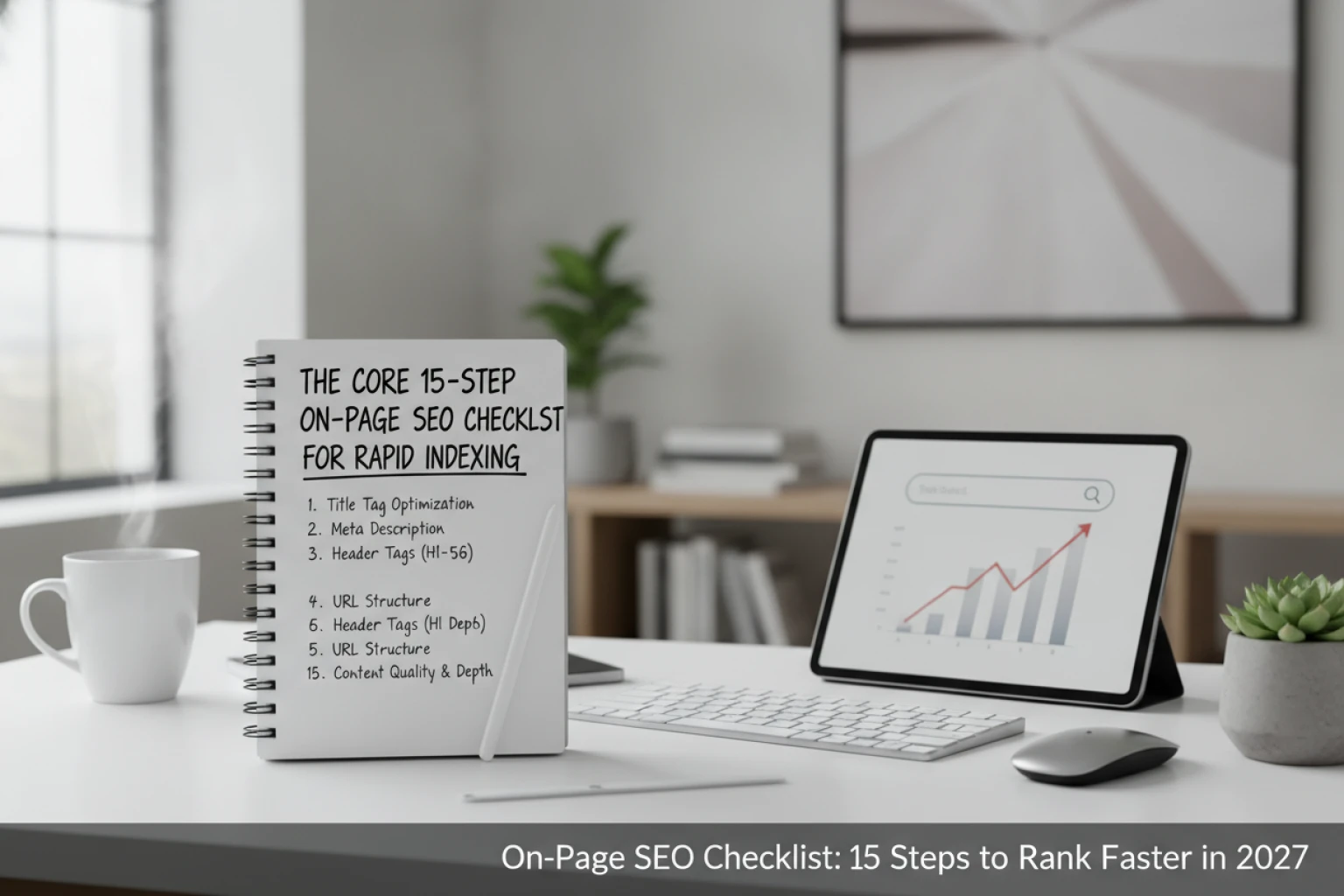
The Core 15-Step On-Page SEO Checklist for Rapid Indexing
Getting crawled quickly is one thing; earning indexation on day one requires an intentional structure. Run your pages through this field-tested on-page SEO checklist before hitting publish.
1. Metadata Foundations (Steps 1–4)
Start by front-loading your target term in the H1, but keep it natural—think “SaaS Churn Rates: Real Benchmarks” rather than a clunky keyword mash. Your meta title should use dynamic variables (like current years or pricing) to entice clicks, while the meta description needs a clear benefit statement instead of a passive summary. Finally, keep URLs brutally short: domain.com/saas-churn beats domain.com/blog/2027/03/how-to-fix-saas-churn every time.
2. Architecture & Semantics (Steps 5–8)
State your primary answer within the first 100 words so search engines immediately map page intent. Build your H2 and H3 subheadings around logical sub-topics, folding in related entities rather than repeating the same phrasing. Before shipping, inject JSON-LD schema (Article, FAQ, or Product) so search engines read your attributes without guessing.
| Layer | Priority Action | Common Blunder |
|---|---|---|
| Assets (Steps 9–12) | Serve AVIF or WebP formats | Uploading 4MB raw PNGs |
| UX & Vitals | Reserve image dimensions (width/height) | Layout shifts (CLS) on load |
| Signals (Steps 13–15) | Descriptive internal anchors | Generic “click here” hyperlinks |
3. Media & Internal Pathways (Steps 9–15)
Compress visual assets heavily. Alt text should read like a note to a visually impaired colleague—describe what is in the graphic, not just your target phrase. If you embed calculators or video, lazy-load those scripts so you don’t tank your Core Web Vitals.
Wrap up by pointing 3–5 contextual internal links to newer, related posts using natural anchor text. Link out to authoritative primary sources where you cite hard facts, and ensure your breadcrumb trails render cleanly in your site’s hierarchy. If a visitor gets lost after landing from search, bots will struggle too.
Real-World Examples: Applying the On-Page SEO Checklist to Top-Ranking Pages
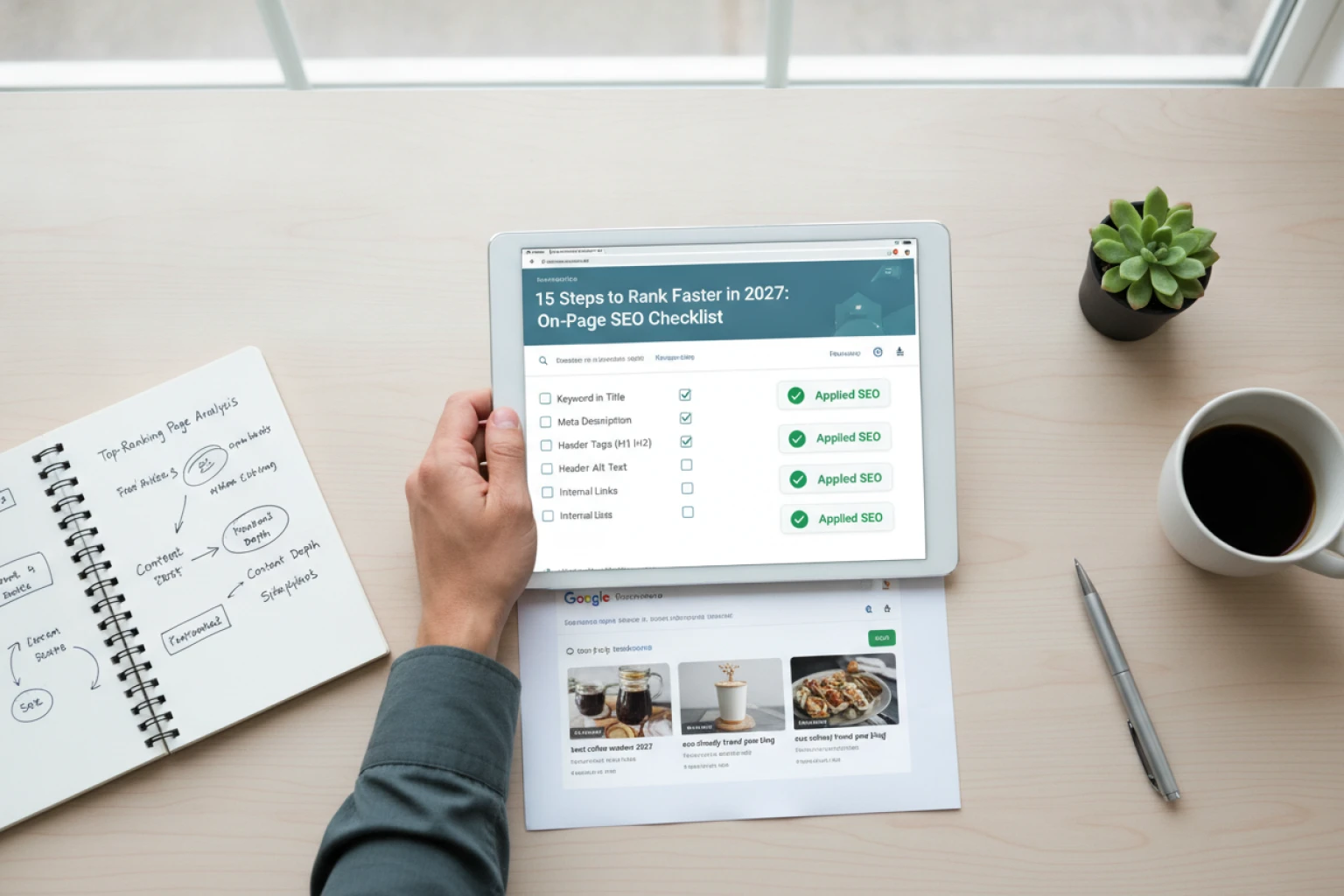
Theory is cheap; seeing what actually moves the needle in Google Search Console is what matters. When you run an audit using an on-page SEO checklist, success usually hinges on fixing small, unsexy structural bottlenecks rather than rewriting thousands of words from scratch.
The SaaS Feature Page Overhaul
A mid-tier workflow automation platform was stuck on page two for its core transactional term. The content was solid, but its H2 tags were creative rather than descriptive (think headers like “Automate the Chaos” instead of “Kanban Board Automation Software”).
We flattened the heading tree so Google’s crawlers could understand parent-child relationships instantly, and swapped basic WebPage markup for detailed SoftwareApplication schema detailing pricing tiers and OS support.
| Optimization Element | Before (Rank #14) | After (Rank #1) |
|---|---|---|
| H2 Architecture | Vague, brand-focused marketing copy | Feature-specific, intent-driven headers |
| Structured Data | None | Validated SoftwareApplication schema |
| Image Assets | IMG_4902.png / “Product UI” | cloud-crm-pipeline-view.webp / “Sales pipeline dashboard showing lead scoring metrics” |
That image rename wasn’t just housekeeping. By shifting to descriptive filenames and intent-rich alt text, the page picked up qualified visual traffic through Google Lens and visual search packs—users literally searching for interface screenshots to compare UI layouts before buying.
The B2B Informational Guide Refresh
On a technical cybersecurity piece, the draft suffered from missing semantic context. Instead of treating keywords as isolated strings, we mapped the missing core entities: NIST framework tiers, credential harvesting vectors, and session hijacking protocols.
We cut three generic external links to Wikipedia and added four high-intent internal links pointing directly to the company’s enterprise pricing and endpoint audit pages. Pairing those tighter internal connections with cleaner, flat URL paths stripped out unnecessary parameter chains.
The payoff showed up directly in the server logs: crawl budget waste dropped by roughly 35%, with Googlebot cycling back to inspect new subheadings within 48 hours instead of the usual two-week crawl lag.
ommon On-Page Mistakes That Delay Indexing and Hurt Rankings
Even a meticulous on-page SEO checklist falls apart if you build strong signals on top of a broken foundation. Most indexing lag doesn’t stem from Google being slow; it happens because your site sends mixed, frustrating signals to search crawlers.
Here are the silent killers that derail performance before a page ever gets off the ground:
- Keyword cannibalization: Publishing three separate articles targeting identical queries like “enterprise billing software” forces search engines to guess which URL matters. They usually end up rotating all three through lower positions instead of ranking one on page one. Pick a distinct primary search intent for every single URL.
- Over-engineered internal link anchors: Bludgeoning every contextual link with the exact target keyword screams manipulation. Real editorial links use varied phrasing. Aim for natural sentence fragments over robotic match-types.
- Locking body copy behind heavy scripts: If your best technical answers live inside client-side JavaScript, unindexed shadow DOM elements, or nested accordion tabs, Googlebot may defer rendering for days—or skip that text entirely during its initial crawl pass.
- Treating mobile viewports as an afterthought: Google operates on mobile-first indexing, period. If your desktop layout displays 1,500 words of rich content but your mobile template hides half of it to save screen space, the search engine considers that hidden text secondary.
| Implementation Choice | Crawl-Safe Approach | High-Risk Mistake |
|---|---|---|
| Internal Linking | Descriptive phrases (“read our setup tutorial”) | Repetitive exact matches (“best CRM software”) |
| Rich Page Content | Server-side rendered (SSR) HTML | Lazy-loaded client-side JS tabs |
| Mobile UX | Full content parity across devices | Stripping text or media on small screens |
When diagnosing a sudden drop in crawl velocity, check your raw server logs and inspect URLs in Search Console before rewriting copy. More often than not, the issue isn’t the quality of your writing—it’s an accidental technical roadblock stopping crawlers from reading it cleanly.

Source-Backed Guidance: Search Engine Guidelines and E-E-A-T Alignment
Google’s Quality Rater Guidelines don’t reward pages that simply summarize the top three search results. If your draft answers an intent by rephrasing existing pages, algorithms treat it as redundant inventory.
To score high on Information Gain, every page must bring net-new value to the index. That means adding proprietary data, counter-intuitive case studies, or firsthand screenshots of an experiment that failed. Here is how that plays out in your day-to-day on-page SEO checklist:
| Quality Signal | What Fails Google’s Bar | What Demonstrates Real E-E-A-T |
|---|---|---|
| Experience | “We tested tools” without proof | Screenshots of tool dashboards, real error logs, and dated setup notes |
| Author Identity | Generic admin byline with no outbound links | Named author box linking to verified LinkedIn, personal domain, or published work |
| Information Gain | Rewritten SERP definitions | Original survey data, custom benchmark metrics, or dissenting technical opinions |
Structured data bridges that gap between raw text and machine understanding. Don’t just paste standard JSON-LD from an online generator and walk away. Test your code directly through Google’s Rich Results Test and validate your types against Schema.org documentation.
A common misstep is wrapping low-authority contributors in detailed Person schemas. If the author doesn’t have an established digital footprint, inflating their credentials with nested schema markup can trigger manual review flags for deceptive metadata.
Finally, treat AI writing assistants as drafting tools rather than publishers. Search engines officially care about quality over origin, but raw AI output leans heavily on common-denominator consensus. If a paragraph sounds plausible but lacks a firm point of view, cut it. Your editorial review should verify every citation, replace generic metaphors with real working examples, and ensure your final advice reflects hands-on human judgment.

Frequently Asked Questions About On-Page Optimization Timelines
How long does it actually take for on-page SEO changes to reflect in rankings?
Most shifts take between two to six weeks, but that window swings widely based on site authority. A high-crawl site like an established news outlet might see title tag tweaks reflect by morning. If you run a smaller niche site, Googlebot won’t circle back as often. Even after recrawling, Google needs time to recalculate ranking signals across the broader index.
Update legacy content or publish new URLs first?
Update your older URLs first—almost always. A page that already has backlinks and historical trust responds to an on-page SEO checklist much faster than a blank slate.
| Strategy | Speed to Impact | Best Used When… |
|---|---|---|
| Refreshing Legacy Pages | 2–4 weeks | The URL sits on pages 2–3 with decayed traffic |
| Publishing New URLs | 3–6 months | You have a clear topical gap with zero current coverage |
Don’t touch old URLs that already print revenue and rank in top spots; save the heavy edits for decaying pages sitting in positions 11 through 30.
How many internal links belong in a 1,000-word piece?
Aim for 3 to 5 natural contextual links per 1,000 words. Forcing two links into every single paragraph looks desperate, confuses readers, and dilutes the equity passed to target pages. Link only where the reader genuinely needs more background to understand the subtopic.
How can you verify that search crawlers noticed your changes?
Skip third-party rank trackers when verifying indexation—they lag behind reality. Instead:
- Run the live page through the URL Inspection tool in Google Search Console.
- Check the “Last crawl” timestamp to confirm the date aligns with your edits.
- View the crawled HTML or rendered screenshot inside the tool to ensure the crawler processed your new headings and text rather than serving an older cached version.

Action Plan: Executing This On-Page SEO Checklist Across Your Site
Running a site-wide update is where most marketing teams stall out. They try to overhaul 200 blog posts at once, burn their editorial budget in three weeks, and see zero lift because they spread their effort too thin.
To make this on-page SEO checklist work without derailing your team’s weekly output, focus strictly on triage. Start by pulling your top 30 decaying URLs from Google Search Console—pages that sat on page one six months ago but have quietly drifted to positions 8 through 15.
Before anyone writes a new word of copy, clear the low-effort fixes first. A rewritten title tag or added structured data takes ten minutes and can recover lost positions without touching the draft. Save heavy rewrites for pages that truly suffer from thin depth or shifted search intent.
| Task Type | Focus Areas | Typical Turnaround | Primary Impact |
|---|---|---|---|
| Tier 1: Quick Technical | Meta titles, missing schema, LCP image compression | Under 30 mins | CTR bumps, snippet eligibility |
| Tier 2: Content Lift | Adding missing subtopics, original data, internal links | 2–4 hours | Intent alignment, ranking jumps |
Before publishing your edits, pin down a snapshot of your baseline metrics. In Search Console, export the last 28 days of data for that exact URL—specifically its average position, total impressions, and CTR for its top three queries. Add an annotation in your analytics dashboard on the exact day changes go live.
Finally, build a two-person sign-off into your CMS workflow:
- Editorial check: Verify that the page genuinely answers the query within the first two scrolls, cuts unnecessary preamble, and reads naturally on mobile.
- Technical validation: Run the live URL through the Rich Results Test to catch broken JSON-LD and check that newly added images include descriptive alt text rather than keyword dumps.
Wait at least three weeks before tweaking the copy again. Search engines need time to recrawl, reindex, and test user engagement on your refreshed page before showing you clean ranking data.

Conclusion
Treating an on-page SEO checklist like a strict rulebook is usually where good sites go wrong. The goal isn’t green lights in a plugin. It’s making sure a search engine instantly grasps what you offer while a human actually stays to read it.
Here’s the reality: you can dial in your headers, clean up your internal linking, and compress your images to the byte, but none of it moves the needle if the page doesn’t solve the searcher’s immediate problem. On-page work gives your expertise a fighting chance to be seen—it doesn’t replace the expertise itself.
When prioritizing your fixes, context matters more than completing every step equally:
| Focus Area | When to Prioritize | When to Leave It Alone |
|---|---|---|
| Search Intent Match | Stagnant rankings outside page one | You already hold top-three positions |
| Internal Linking | Deep product pages with zero impressions | High-authority pages with tight topic focus |
| Schema Markup | Entities, FAQs, or rich snippet targets | Plain narrative essays or opinion pieces |
Before you publish your next piece, run through this quick sanity check:
- Did you answer the primary query before the reader has to scroll twice?
- Are your links pointing to natural next steps, or did you drop them in just to spread equity?
- If you stripped out every image and styled block, does the core text still teach something specific?
Don’t over-optimize every single draft until it reads like a machine wrote it for another machine. Build the page for clarity first, polish the technical signals second, and let the content earn its spot.

