

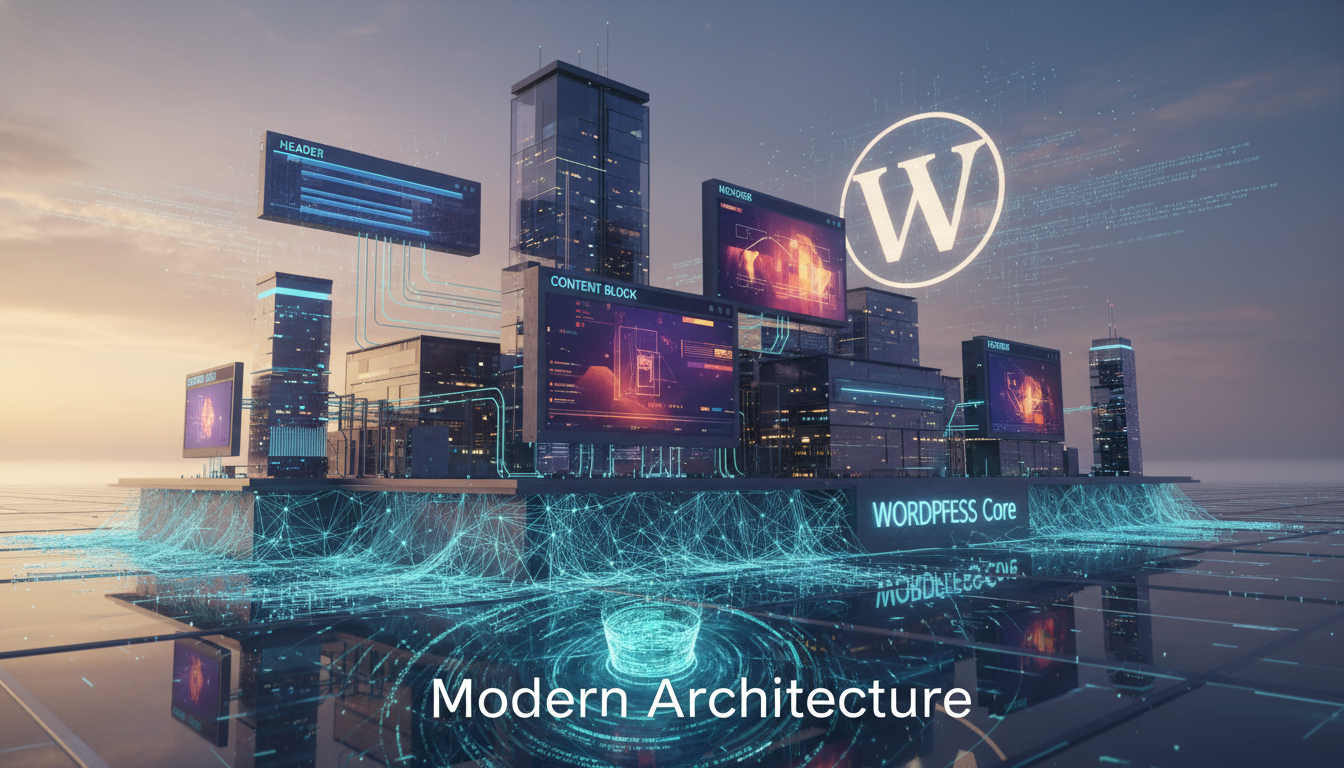
Three months ago, a client handed me the keys to a digital disaster. The front-end looked spectacular. Crisp typography. Fluid animations. A visual masterpiece. But beneath the surface? A labyrinth of forty-two active plugins and an options table groaning under eight hundred megabytes of autoloaded transients. It took twelve seconds for the server to respond. Twelve. This happens constantly across our industry. Agencies focus heavily on the visual layer, completely ignoring the structural foundation. Real performance requires a fundamental shift in how we approach rendering and architecture.WordPress Website Design
The Hidden Architecture of Modern WordPress Website Design
Most developers treat the content management system as a black box. You install a theme, layer on a page builder, and call it a day. This is the exact recipe for structural bloat. True architectural integrity starts at the database level long before a single pixel is painted on the screen. During my initial audits of high-traffic sites, I almost always find the `wp_options` table in a state of absolute chaos. Every time a plugin is installed and removed, it leaves behind orphaned data. When a site loads, WordPress queries this table and loads every row marked with `autoload=yes` into memory.WordPress Website Design
If you have five hundred megabytes of orphaned transient data, your server is loading that into RAM on every single page request. I routinely write custom MySQL queries to identify and purge these orphaned records. You have to strip the architecture down to its bare metal. Tracking these core structural changes requires keeping a close eye on the official WordPress core documentation to anticipate deprecations and database schema shifts before they break your production environment. By maintaining a lean database, you drastically reduce Time to First Byte (TTFB), which is the absolute baseline for any fast application.WordPress Website Design
Moving Beyond Pre-Packaged Themes
The era of purchasing a heavy, multi-purpose theme from a marketplace is over. We have entered the age of Full Site Editing (FSE). Instead of scattering CSS variables across dozens of disjointed stylesheets, I now utilize `theme.json` to enforce strict design discipline. This single configuration file dictates the exact typography scales, color palettes, and layout constraints available to the content editors. It removes the temptation for editors to introduce inline styles that bloat the Document Object Model (DOM).WordPress Website Design
When you transition away from legacy PHP template hierarchies toward block-based themes, you are essentially serving static HTML directly from the database rather than forcing the server to process complex PHP loops on every request. I recently migrated a heavy publishing portal to a custom block architecture. We reduced the server response time by seventy percent simply by eliminating the legacy theme framework. The client thought it was magic. It was just basic data hygiene.WordPress Website Design
Core Web Vitals in WordPress Web Design Performance
Visual aesthetics do not matter if the browser struggles to render the content. Google fundamentally shifted the landscape when they introduced their specific performance metrics. If you want to validate these metrics accurately, running audits against Core Web Vitals metrics is non-negotiable. I obsess over Largest Contentful Paint (LCP) and Cumulative Layout Shift (CLS). The most common mistake I see? Lazy-loading the hero image.
Developers often install optimization plugins that blindly apply `loading=”lazy”` to every image tag on the page. When the browser parses the HTML, it sees the hero image—the most important visual element above the fold—and delays loading it until the rest of the DOM is ready. This artificially inflates the LCP score, signaling to search engines that your site is sluggish. I specifically configure my templates to preload the hero image using link headers while deferring all non-critical assets. It is a precise surgical operation, not a blanket toggle in a plugin settings panel.
Navigating DOM Size Dilemmas
Page builders are notorious for creating div-ception. To render a simple text box, a popular visual builder might nest the paragraph tag inside six distinct wrapper divs. Multiply that by fifty elements on a page, and you suddenly have a DOM size exceeding three thousand nodes. The browser has to calculate the styling and position for every single node. This paralyzes mobile devices.WordPress Website Design
My approach is aggressive reduction. I build custom native blocks using React. A custom block outputs exactly the semantic HTML required and nothing more.
Security Protocols for Custom WordPress Site Creation
Security is rarely considered a design element, yet a compromised site loses all user trust immediately. I treat security as a foundational layer of the build process. The default configuration of the platform is inherently vulnerable if left unchecked. The first thing I do on any new deployment is disable XML-RPC. This legacy API is an open door for brute-force attacks and is entirely unnecessary for modern applications.WordPress Website Design
Next, we address the REST API. While incredibly powerful, leaving it completely open exposes author usernames and potential endpoint vulnerabilities. I implement strict authentication protocols, ensuring that only authenticated requests can query sensitive data routes. Hardening the infrastructure requires meticulous attention to server-side configurations, something that cannot be resolved merely by installing a security plugin.
Hardening the Database Layer
Changing the default `wp_` database prefix is elementary, yet staggering numbers of enterprise sites fail to do it. Furthermore, I routinely rotate the cryptographic salts defined in the configuration file. If a session hijacking attempt occurs, rotating these salts immediately invalidates all active cookies, forcing a global logout. It is a harsh but necessary tactic when mitigating active threats. Security must be proactive, built directly into the deployment pipeline through automated vulnerability scanning before code ever reaches the production server.WordPress Website Design
Headless Applications: The Future of WordPress Website Design?
Sometimes, the traditional monolithic structure is simply inadequate for the client’s needs. I recently architected a solution for a client requiring a lightning-fast e-commerce experience seamlessly blended with heavy editorial content. The solution was decoupling the system entirely. We transitioned to a headless architecture.
By treating the CMS strictly as a data repository, we empower content editors to keep using the familiar Gutenberg interface they already know. Meanwhile, the front-end is entirely divorced from the backend, built using modern JavaScript frameworks like Next.js. We use WPGraphQL to expose the content, allowing the Node.js server to query only the specific data points required for the current view.
Decoupling the Front-End Logic
This decoupled approach completely eliminates traditional attack vectors. There is no database connected to the front-end server. There is no PHP executing on the client side. We serve statically generated pages that load instantaneously via edge networks. The complexity of the build process increases significantly, but the sheer performance and security benefits make it the definitive choice for enterprise-level platforms handling massive concurrent traffic spikes.WordPress Website Design
Accessibility Standards in Professional Layouts
We cannot discuss modern builds without addressing accessibility. Too many developers treat ARIA labels and screen-reader compatibility as an afterthought, slapped on during the final days of a project. I integrate accessibility audits into the very first wireframing sessions. Semantic HTML is not just an SEO play. Referencing the MDN Web Docs on accessibility reminds us that structural integrity dictates how assistive technologies interpret the page WordPress Website Design.
Contrast ratios must exceed WCAG AA standards strictly. Keyboard navigation must follow a logical focus state order without trapping the user in infinite loops. I rely heavily on custom focus outlines tailored to the brand’s aesthetic, proving that accessibility does not have to compromise the visual design. When a site is natively accessible, it is inherently easier for search engine bots to crawl and index the content efficiently.
Future-Proofing Your WordPress Website Design Strategy
The digital ecosystem demands constant iteration. Static methodologies perish quickly. We are currently witnessing a massive shift toward artificial intelligence integrations natively within the block editor, allowing for dynamic content generation and automated layout adjustments. To stay relevant, your architecture must be modular. Hardcoding specific functionalities into theme files guarantees obsolescence.WordPress Website Design
WordPress Website Design.I advise clients to build discrete, single-purpose plugins for custom functionalities rather than cramming everything into a monolithic functions file. If you decide to redesign the visual layer in three years, your functional logic remains intact and untouched. When executing these highly specialized, enterprise-level deployments, partnering with sophisticated agencies like UDM ensures that these technical fundamentals translate seamlessly into flawless front-end visual execution. Their structural approach aligns perfectly with the strict architectural demands required for high-performance applications. The true art of modern web development lies not in what the user sees, but in the invisible, perfectly optimized machinery running silently underneath.


