

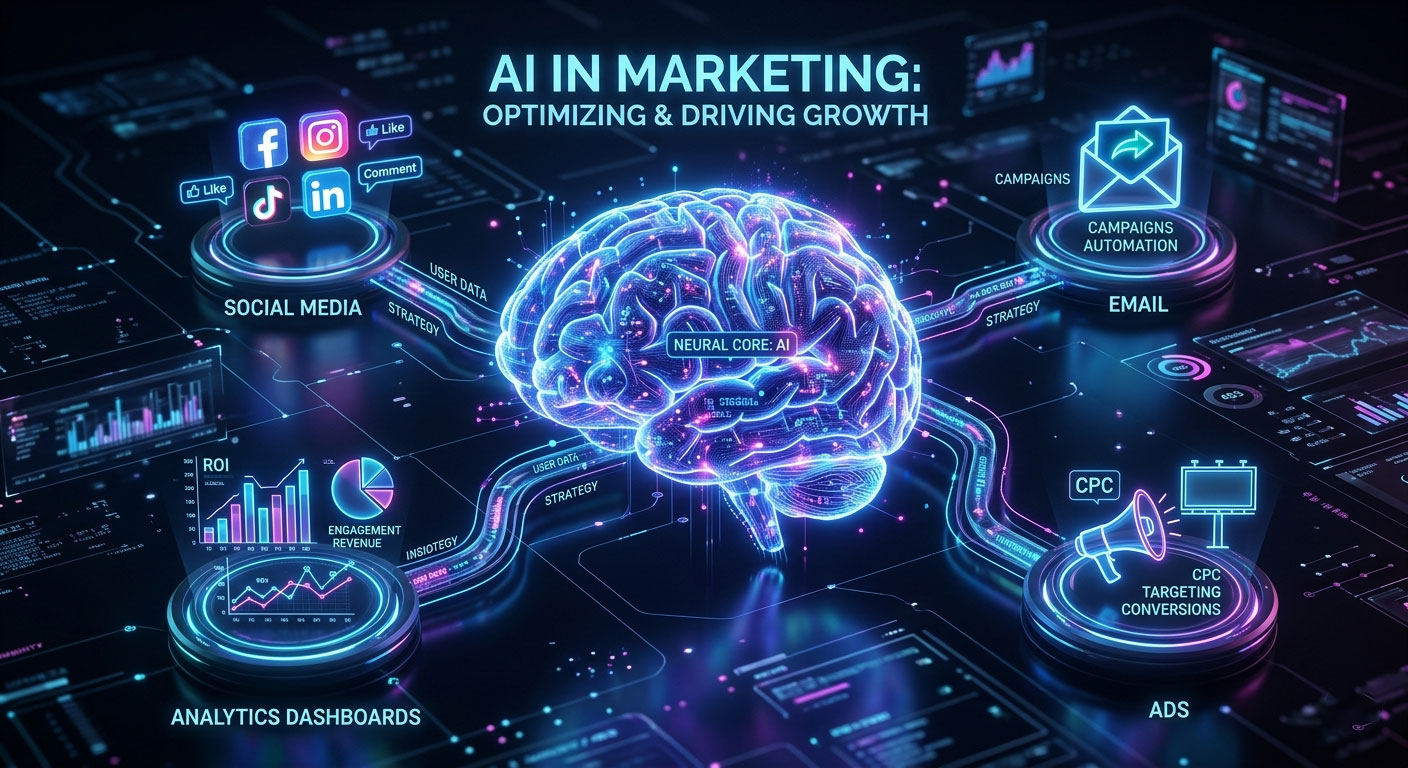
Why AI in Marketing Is No Longer Optional
Introduction
The way businesses connect with their customers has changed dramatically. Moreover, this change is happening faster than most companies expected. AI in marketing is no longer a futuristic idea. It is a working reality that brands of all sizes are using right now to grow faster and smarter.
In 2026, customers expect personalized experiences. They want brands to understand their needs before they even ask. Therefore, businesses that rely on guesswork are falling behind. AI tools allow marketers to analyze data, predict behavior, and deliver the right message at the right time.
However, many business owners still feel unsure about where to start. The good news is that you do not need a massive budget or a technical team to use AI in your marketing strategy. In addition, you do not need to replace your entire team. AI works best when it supports human creativity and decision-making.
From freight and logistics to e-commerce and service businesses, AI is helping companies increase their return on investment. Businesses like JKC Cargo are discovering that smarter marketing means faster growth and stronger customer relationships. Therefore, understanding how AI fits into your marketing plan is one of the most important steps you can take in 2026.
This article will walk you through the most practical and proven AI marketing strategies. Furthermore, it will show you how to apply them in ways that actually move the needle for your business.
What AI in Marketing Actually Means
Before jumping into strategies, it is important to understand what AI in marketing really means. It is not about robots taking over. Instead, it is about using intelligent software to handle tasks that used to take hours of manual work.
AI tools can read customer data, spot patterns, and make decisions in seconds. Moreover, they can do this at a scale that no human team could match alone. As a result, your marketing becomes more efficient and more effective at the same time.
In simple terms, AI helps you work smarter. It removes the guesswork from your campaigns and replaces it with data-driven clarity.
Personalization at Scale Using AI
One of the most powerful uses of AI in marketing is personalization. However, personalization used to be expensive and time-consuming. Now, AI makes it possible for any business to deliver personal experiences to thousands of customers at once.
AI tools track what users browse, what they buy, and what they ignore. Therefore, they can show each customer content or products that match their specific interests. This is not generic advertising. It is a one-to-one conversation at scale.
For example, if a customer regularly ships cargo from Islamabad to Dubai, an AI system can automatically show them relevant shipping deals, updates, and service options. In addition, it can send them reminders at the right time in their buying journey.
Moreover, personalized emails generate significantly higher open rates than generic ones. When your audience feels seen and understood, they are far more likely to take action.
AI-Powered Content Creation and Strategy
Content is still king in digital marketing. However, creating consistent, high-quality content takes a lot of time. This is where AI steps in to help.
AI writing tools can generate blog ideas, draft outlines, and even write full articles based on your target keywords. Furthermore, they can analyze which topics your competitors are ranking for and identify gaps you can fill.
However, the best results come when humans guide the process. AI should be used as a starting point, not a replacement for genuine expertise. Therefore, always review, personalize, and improve any AI-generated content before publishing it.
In addition, AI tools can analyze which content formats perform best for your audience. For instance, does your audience engage more with short videos, detailed guides, or infographics? AI helps you answer that question with real data instead of assumptions.
Moreover, using AI to manage your content calendar ensures that you stay consistent. Consistency is one of the biggest factors in building trust and search engine rankings.
Smarter Customer Segmentation With AI
Traditional customer segmentation groups people into broad categories. However, AI takes this much further. It creates highly specific audience segments based on dozens of data points at once.
AI tools can segment your audience by location, behavior, purchase history, device usage, and even the time of day they are most active. Therefore, your campaigns can speak directly to each group in a way that feels relevant and timely.
For a logistics company like JKC Cargo, this means targeting importers differently from exporters. Moreover, it means showing different messaging to first-time customers compared to loyal repeat clients. This level of precision makes every marketing dollar work harder.
In addition, AI updates these segments automatically as customer behavior changes. Therefore, you are never working with outdated audience data. Your strategy stays sharp and current without extra manual effort.
Predictive Analytics: Marketing Before the Customer Asks
Predictive analytics is one of the most exciting areas of AI in marketing. It uses historical data and patterns to forecast what a customer is likely to do next.
For example, if a customer has shipped cargo twice in the last six months, AI can predict when they might need to ship again. Therefore, your marketing team can reach out at exactly the right moment with a relevant offer. This feels helpful rather than pushy.
Moreover, predictive analytics can tell you which leads are most likely to convert. As a result, your sales team can focus their time and energy on the highest-value opportunities. This saves time and increases revenue.
In addition, predictive tools can forecast demand for your services at different times of the year. Therefore, you can plan campaigns around those peaks and make the most of high-traffic periods.
AI Chatbots for Lead Generation and Customer Support
AI chatbots have come a long way. Moreover, they are now one of the most practical tools for converting website visitors into leads. A well-built chatbot works around the clock, answers questions instantly, and guides customers through the buying process.
For a cargo and logistics website, a chatbot can answer questions about shipping rates, customs requirements, and delivery timelines. Therefore, customers get fast answers without waiting for a human agent. In addition, the chatbot can collect contact information and pass it directly to your sales team.
However, the key is to make your chatbot feel natural. Customers should not feel like they are talking to a robot. Therefore, design your chatbot conversations to sound warm, clear, and helpful.
Moreover, AI chatbots learn over time. The more conversations they have, the better they get at understanding customer questions and providing accurate answers. As a result, your customer experience keeps improving without additional investment.
AI in Email Marketing: Timing and Targeting Done Right
Email marketing remains one of the highest-returning channels in digital marketing. However, the difference between a successful email campaign and one that gets ignored often comes down to timing and relevance.
AI tools analyze when each individual subscriber is most likely to open an email. Therefore, instead of sending to your entire list at 9 AM on Monday, AI sends each email at the ideal time for that specific person. This alone can significantly improve open rates.
Moreover, AI can test different subject lines, images, and call-to-action buttons automatically. It identifies which version performs better and applies those findings in real time. This process is called A/B testing, and AI makes it continuous and automatic.
In addition, AI in email marketing can trigger messages based on specific behaviors. For example, if a customer visits your pricing page but does not request a quote, an automated follow-up email can go out within hours. This kind of timely response often makes the difference between a lost lead and a new customer.
Using AI for SEO and Search Strategy
Search engine optimization is one of the areas where AI has made the biggest impact. Furthermore, AI tools now help businesses understand exactly what their target audience is searching for and why.
AI-powered SEO platforms can analyze thousands of keywords at once. They can identify which terms are growing in popularity, which have low competition, and which match your customer’s buying intent. Therefore, you can create content that ranks faster and attracts the right visitors.
Moreover, AI can audit your existing website and identify technical issues that may be hurting your rankings. Things like slow page speed, broken links, or missing meta descriptions can all drag down your visibility. AI finds these problems quickly and suggests fixes.
In addition, AI helps you understand search trends before they peak. Therefore, you can publish content ahead of the competition and establish your authority early. For a business in the cargo and logistics industry, this means showing up when potential customers search for freight solutions in your market.
AI-Driven Paid Advertising for Better ROI
Paid advertising through Google Ads or social platforms can be very expensive if not managed carefully. However, AI dramatically improves the efficiency of paid campaigns by automating bidding, targeting, and creative testing.
AI bid management tools adjust your ad spend in real time based on performance data. Therefore, your money goes where it produces the best results. Moreover, they can pause underperforming ads automatically and shift budget toward winning campaigns.
In addition, AI tools use audience data to find people who look similar to your best existing customers. This is called lookalike targeting, and it is one of the most effective ways to reach new prospects who are likely to convert.
Furthermore, AI analyzes your ad creative performance and identifies which images, headlines, and offers resonate most with your audience. Therefore, you can continuously improve your campaigns without waiting weeks for results.
Building a Data-First Marketing Culture With AI
All of these strategies work best when your business embraces a data-first mindset. Moreover, AI makes it easier than ever to collect, organize, and act on marketing data.
However, data is only useful when you know what to do with it. Therefore, businesses should invest time in understanding their key metrics. What does a good conversion rate look like in your industry? How long does your average customer take to make a buying decision?
AI tools can answer these questions by analyzing your historical data. Furthermore, they can set benchmarks and alert you when something is performing above or below expectations.
In addition, AI helps you connect data from different channels. Your website traffic, email opens, social media engagement, and sales data can all be analyzed together. As a result, you get a complete picture of your marketing performance instead of isolated snapshots.
Conclusion: AI in Marketing Is Your Competitive Edge in 2026
The businesses that grow fastest in 2026 are the ones that embrace AI in marketing with a clear strategy and an open mind. Moreover, the barrier to entry has never been lower. You do not need a massive team or an enormous budget to start seeing real results.
Throughout this article, we explored how AI transforms personalization, content creation, customer segmentation, predictive analytics, chatbots, email marketing, SEO, and paid advertising. Therefore, no matter which area of marketing you want to improve, there is an AI tool built to help you do it better and faster.
However, the most important thing to remember is this: AI works best alongside human creativity, not instead of it. Your team’s knowledge, relationships, and judgment are still your greatest assets. In addition, AI simply gives those assets more power and precision.
For businesses like JKC Cargo, applying AI in marketing means reaching the right customers at the right moment with the right message. Furthermore, it means turning data into decisions that drive real growth. Therefore, if you have not already started exploring AI tools for your marketing strategy, now is the best time to begin.
The competition is moving forward. Moreover, your customers already expect smarter, faster, and more personalized experiences. Therefore, do not wait for the perfect moment. Start small, measure your results, and build from there. AI in marketing is not the future. It is the present, and it is available to you right now.
Frequently Asked Questions
Q1: How does AI in marketing help small businesses compete with larger brands?
AI levels the playing field by automating tasks that used to require large teams and big budgets. Small businesses can use AI tools to personalize their messaging, run smarter ad campaigns, and analyze customer behavior in real time. Therefore, even a small cargo company can deliver the kind of experience that was once only possible for enterprise-level brands.
Q2: Is AI in marketing suitable for the logistics and cargo industry?
Absolutely. In fact, the logistics industry benefits enormously from AI in marketing. AI tools help cargo companies identify high-value shipping leads, predict seasonal demand, personalize customer communication, and automate follow-ups. Moreover, AI-powered chatbots can handle customer inquiries around the clock, which is especially valuable for businesses that serve international clients across different time zones.
Q3: What is the easiest way to start using AI in a marketing strategy?
The easiest starting point is email marketing automation. Most email platforms now include AI features that optimize send times, personalize subject lines, and trigger messages based on customer behavior. In addition, AI chatbots are another low-effort, high-impact tool that can be added to your website quickly. Therefore, you do not need to overhaul your entire strategy at once. Start with one tool, measure the results, and expand from there.
If you want to make your ERP system you can contact us or directly call us our details are as follows:
Contact us via contact page :- https://udmcreative.com/contact/
Direct call us :- 03475159209
Location :- Sector C2 Haris Plaza Mirpur Azad Kashmir
Google Map:-


