

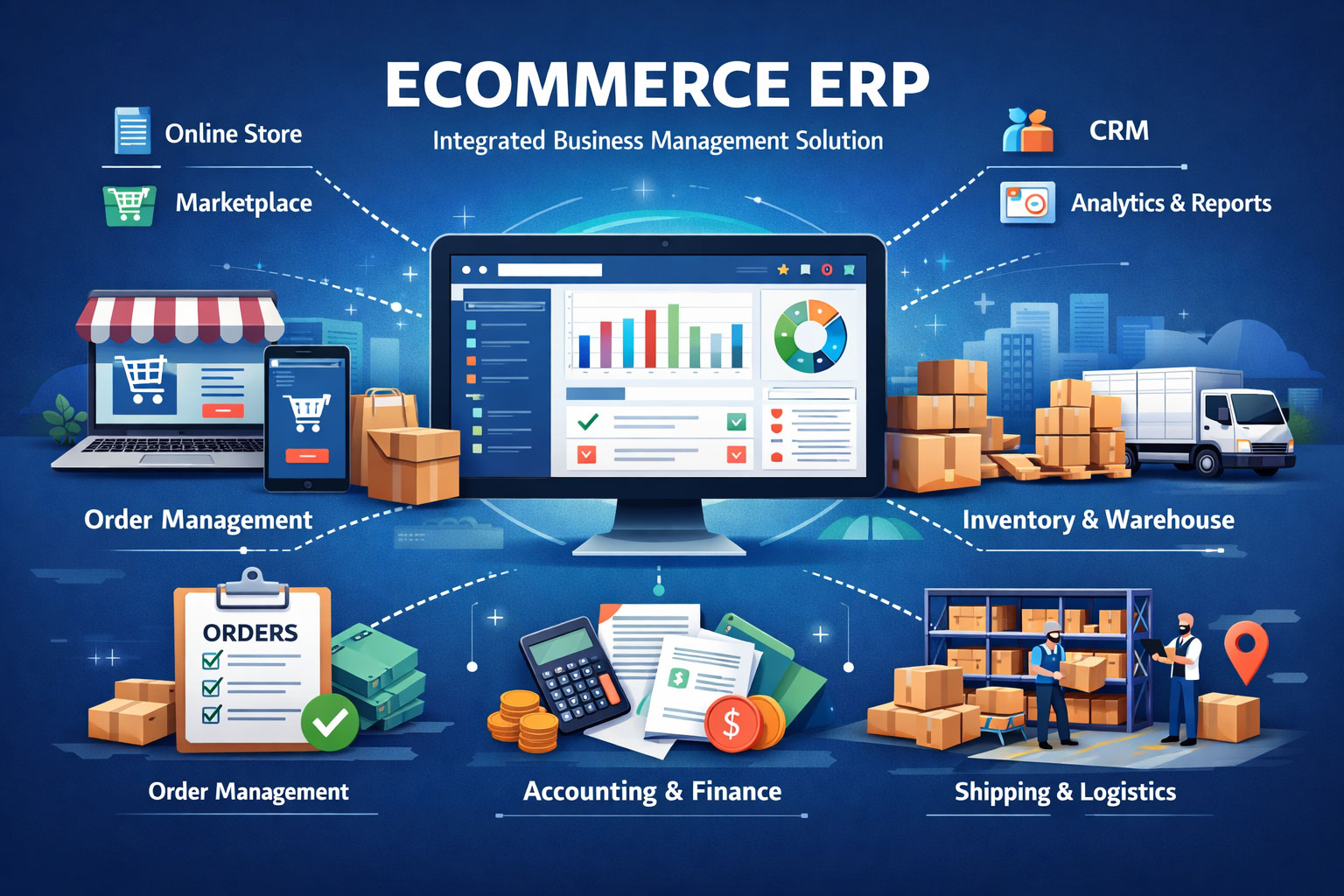
Imagine your online store booming. Orders are pouring in, new products are flying off the digital shelves, and your customer base is expanding at an incredible rate. It’s the dream, right? But here’s a question: are your backend systems ready for that dream to become a reality? Or will rapid growth expose the cracks, turning your success into a logistical nightmare? For many ambitious ecommerce businesses, the answer lies in a powerful, adaptable solution: an Ecommerce ERP that’s designed not just for where you are today, but for where you’re going tomorrow. It’s more than just software; it’s the operational backbone that empowers you to chase big goals without breaking a sweat, or your budget.
The Evolving Landscape: Why a Scalable Ecommerce ERP Isn’t Just a Luxury, It’s a Necessity
The world of ecommerce moves at lightning speed. What worked last year might be outdated next month. From shifting consumer behaviors to the proliferation of sales channels and the ever-present demand for instant gratification, online businesses face constant pressure to adapt and perform. In this dynamic environment, relying on fragmented systems or manual processes is like trying to win a Formula 1 race with a bicycle – you might start, but you won’t finish ahead. This is where a robust and scalable Ecommerce ERP system steps in, transforming potential chaos into streamlined efficiency.
Beyond Basic Operations: Understanding what an Ecommerce ERP truly is
At its core, an Ecommerce ERP (Enterprise Resource Planning) isn’t just about managing orders or inventory. It’s a sophisticated, centralized system that integrates and automates all your core business processes specifically tailored for online retail. Think of it as the central nervous system for your entire ecommerce operation. It connects everything from inventory management and order processing to financial accounting, customer relationship management (CRM), supply chain logistics, and even marketing efforts. Instead of having separate software for each function that barely “talks” to each other, an Ecommerce ERP provides a single source of truth, giving you a holistic, real-time view of your business. This integration is crucial because in ecommerce, every department is interconnected – a sale impacts inventory, which impacts purchasing, which impacts finance, and ultimately, customer satisfaction. Without this central hub, data becomes siloed, leading to inefficiencies and missed opportunities.
The Growth Paradox: How rapid expansion can expose inefficiencies and bottlenecks
It’s a wonderful problem to have: your business is growing! But growth, especially rapid growth, can be a double-edged sword. While increased sales bring revenue, they also bring exponential increases in operational complexity. If your existing systems – perhaps a combination of spreadsheets, basic accounting software, and your ecommerce platform’s built-in tools – aren’t designed to handle this increased volume, they will quickly become bottlenecks. You might find yourself hiring more people just to manage manual data entry, spending countless hours reconciling discrepancies, or worse, making critical decisions based on outdated or inaccurate information. This “growth paradox” is a common trap for successful online retailers; the very thing you strive for can become your biggest operational hurdle if your foundation isn’t solid.
The Cost of Inaction: Briefly touch upon the hidden expenses and lost opportunities of fragmented systems and manual processes
Many businesses hesitate to invest in an Ecommerce ERP, viewing it as a significant upfront cost. However, the cost of not investing is often far greater, though less obvious. Fragmented systems lead to a host of hidden expenses:
- Increased labor costs: Manual data entry, duplicate work, and error correction eat up valuable employee time that could be spent on strategic initiatives.
- Inventory inaccuracies: Overselling leads to angry customers and cancellations; stockouts lead to lost sales and frustrated shoppers who go elsewhere. Both directly impact your bottom line and brand reputation.
- Inefficient fulfillment: Slow order processing, shipping errors, and complicated returns chew into profitability and customer loyalty.
- Poor decision-making: Without real-time, consolidated data, you’re flying blind, unable to identify profitable products, optimize marketing spend, or forecast demand accurately.
- Stagnated innovation: When your team is constantly putting out fires and wrestling with inefficient systems, there’s little time or energy left for innovation, product development, or improving the customer experience. These hidden costs erode your margins and prevent your business from reaching its full potential, making the initial investment in a scalable Ecommerce ERP look like a bargain by comparison.
Setting the Stage: Why choosing the right Ecommerce ERP from the start can be the single most impactful decision for sustainable growth
Choosing the right Ecommerce ERP isn’t just a tech upgrade; it’s a strategic business decision that lays the groundwork for sustainable, profitable growth. It’s about building a future-proof foundation that can absorb increasing volumes, adapt to new sales channels, and provide the insights you need to make smart, data-driven choices. When implemented correctly, a scalable Ecommerce ERP becomes an accelerator, freeing up resources, improving efficiency, and giving you the competitive edge needed to thrive in the ever-evolving ecommerce landscape. It allows you to focus on what you do best: growing your business and delighting your customers, rather than getting bogged down in operational minutiae.
The Pain Points: When Your Current Systems Can’t Keep Up with Ecommerce Growth
Every ecommerce entrepreneur dreams of rapid growth, but few anticipate the operational chaos that can ensue if their backend systems aren’t ready. As order volumes swell and product lines diversify, the cracks in inadequate systems quickly turn into gaping chasms. Let’s explore some common pain points that signal it’s time for a serious upgrade to a comprehensive Ecommerce ERP.
Inventory Nightmares: From overselling and stockouts to inaccurate counts across multiple channels
This is perhaps the most common and frustrating pain point for growing ecommerce businesses. Imagine selling a product that’s already out of stock – leading to an unhappy customer, a cancelled order, and a damaged reputation. Or, conversely, having too much capital tied up in slow-moving inventory because you couldn’t accurately forecast demand.
- Overselling: When your website shows an item as available, but your warehouse or other sales channels (like Amazon or eBay) have already sold the last unit. This creates immediate customer dissatisfaction and logistical headaches.
- Stockouts: Missing out on sales because your inventory system didn’t alert you to reorder in time, or didn’t accurately reflect available stock.
- Inaccurate counts: Discrepancies between physical inventory and what your system reports, leading to lost products, inefficient picking, and general confusion.
- Multi-channel complexity: Managing inventory across your own website, marketplaces, social commerce, and potentially brick-and-mortar stores becomes a Herculean task without a centralized Ecommerce ERP that provides real-time, synchronized data. This often results in manual adjustments, which are prone to error and incredibly time-consuming.
Order Fulfillment Headaches: The struggle of managing increasing order volumes, complex shipping logic, returns, and customer service inquiries across various platforms
As orders increase, so does the complexity of fulfilling them efficiently. What once was a simple process can quickly become a bottleneck.
- Manual order processing: Copying order details from one system to another, leading to delays and transcription errors.
- Complex shipping logic: Difficulty applying the right shipping rates, carriers, and methods based on product type, destination, or customer preferences.
- Returns management: A disjointed returns process can be a customer service nightmare, leading to delays in refunds or exchanges, and making it difficult to restock returned items efficiently.
- Customer service inquiries: When customer data (order history, shipping status, communication logs) is scattered across multiple systems, providing quick, informed support becomes nearly impossible, leading to frustrated customers and overwhelmed support teams. An Ecommerce ERP unifies this data, giving your service agents a complete view.
Financial Disarray: Inconsistent reporting, manual reconciliation errors, and lack of real-time visibility into profitability, especially with international sales or diverse product lines
Financial health is the lifeblood of any business, but without integrated systems, getting a clear picture can feel like piecing together a jigsaw puzzle with missing pieces.
- Inconsistent reporting: Data from sales, inventory, and accounting systems don’t match up, making it impossible to trust your financial statements.
- Manual reconciliation errors: Hours spent manually matching payments, orders, and inventory movements often lead to mistakes that can be costly and time-consuming to correct.
- Lack of real-time visibility: You can’t see your true profitability per product, channel, or customer segment in real-time, making strategic financial planning a guessing game.
- International sales complexity: Managing multiple currencies, tax regulations, and payment gateways manually is a recipe for compliance issues and accounting nightmares. An Ecommerce ERP streamlines these complexities, offering a consolidated view of your global operations.
Data Silos & Lack of Insights: How disparate systems prevent a holistic view of your business, hindering strategic decision-making and personalized customer experiences
Imagine having all the puzzle pieces but no picture on the box. That’s what data silos feel like. When your sales data lives in one system, customer data in another, and inventory in yet another, you lose the ability to connect the dots.
- No holistic view: You can’t easily see how marketing campaigns impact sales, how inventory levels affect customer satisfaction, or which products are most profitable across all channels.
- Hindered strategic decision-making: Without comprehensive, accurate data, strategic choices about product development, market expansion, or pricing are based on gut feelings rather than hard facts.
- Impaired personalization: Providing personalized customer experiences – tailored recommendations, targeted promotions, or proactive support – is impossible when you don’t have a unified view of each customer’s history, preferences, and interactions.
Stifled Innovation: The time and resources wasted on manual tasks and system workarounds, diverting focus from product development, marketing, and customer engagement
When your team is constantly bogged down by manual processes, correcting errors, and trying to make disparate systems communicate, their creative energy and time are diverted from truly impactful work.
- Reduced productivity: Employees spend more time on administrative tasks than on value-added activities.
- Limited focus on growth: Instead of developing new products, optimizing marketing campaigns, or enhancing the customer journey, your team is stuck in operational quicksand.
- Delayed market entry: The inability to quickly adapt to new trends or launch new initiatives because your systems are too rigid or require too much manual effort. A robust Ecommerce ERP frees up your most valuable asset – your people – to innovate, strategize, and drive your business forward.
Key Features: What to Look for in a Growth-Oriented Ecommerce ERP
Choosing an Ecommerce ERP is a significant investment, and ensuring it can grow with you is paramount. This means looking beyond basic functionalities to features that provide scalability, flexibility, and powerful insights. Here’s a breakdown of what a truly growth-oriented solution should offer.
Robust Inventory & Order Management
This is the bedrock of any successful ecommerce operation. Without accurate and efficient management here, everything else crumbles.
- Real-time synchronization across all sales channels: This is non-negotiable. Your ERP should update inventory levels instantly across your website, marketplaces (like Amazon, Etsy), social media shops, and any physical stores, preventing overselling and stockouts.
- Automated order processing: From receiving an order to generating a shipping label, the system should automate as many steps as possible, reducing manual intervention and speeding up fulfillment. This includes automated order routing to the correct warehouse or dropshipper.
- Multi-warehouse support: As you expand, you might operate from multiple locations. The ERP should seamlessly manage inventory across all of them, optimizing picking, packing, and shipping based on location and cost.
- Efficient returns management: A streamlined process for handling returns, including automated return merchandise authorizations (RMAs), inspection, restocking, and refund processing. This improves customer satisfaction and ensures returned goods re-enter inventory quickly.
- Batch processing & kitting: The ability to process multiple orders at once and manage product bundles or kits, which is crucial for efficiency as volume grows.
Integrated Financial Management
Beyond basic accounting, a growth-oriented Ecommerce ERP offers deep financial insights and automation.
- Automated billing & invoicing: Generate invoices automatically upon order completion, reducing manual effort and errors.
- General ledger, accounts payable/receivable: Full integration with core accounting functions, ensuring all financial transactions are accurately recorded and reconciled.
- Comprehensive reporting for accurate financial health monitoring: Real-time dashboards and customizable reports that provide insights into profitability, cash flow, revenue recognition, and expenses across different channels and product lines. This is vital for strategic financial planning.
- Multi-currency and multi-tax support: Essential for businesses planning international expansion, handling different currencies and navigating complex tax regulations automatically.
Seamless CRM & Customer Service
Your customers are your most valuable asset. An Ecommerce ERP helps you understand and serve them better.
- Centralized customer data: A single repository for all customer information, including contact details, purchase history, communication logs, preferences, and loyalty program status.
- Order history & communication logs: Customer service representatives can instantly access a complete view of a customer’s journey, enabling faster, more personalized, and effective support.
- Tools to deliver consistent, personalized support: Features like ticketing systems, knowledge bases, and automated follow-ups help streamline customer interactions and build stronger relationships.
Supply Chain & Vendor Management
Optimizing your supply chain is key to maintaining healthy margins and keeping products in stock.
- Streamlined procurement: Automate purchase order generation based on inventory levels and sales forecasts, ensuring you reorder at the right time.
- Purchase order management: Track POs from creation to receipt, managing vendor communications, lead times, and payment terms.
>
- Landed cost calculations: Accurately calculate the total cost of g
- Powerful reporting tools: Generate detailed reports on sales trends, product performance, customer behavior, channel profitability, and operational efficiency. Look for drill-down capabilities to explore data at a granular level.
- Forecasting capabilities: Leverage historical data and current trends to predict future demand, sales, and inventory needs, allowing for proactive decision-making.
- The ability to easily add new modules: As your business evolves, you might need new functionalities (e.g., manufacturing, project management). A scalable ERP allows you to add these without a complete overhaul.
- Integrate with third-party apps: Crucially, your Ecommerce ERP must play well with others.
- This includes supporting new sales channels, product types, or business models (e.g., subscription boxes, B2B sales).
oods, including shipping, duties, and other charges, for precise profitability analysis.
Advanced Reporting & Analytics
Data is power, and a good Ecommerce ERP turns raw data into actionable insights.
Scalability & Flexibility
This is the “grows with your business” part.
Choosing Your Future: How to Select an Ecommerce ERP That Scales with YOU
Selecting an Ecommerce ERP is one of the most critical decisions a growing online business will make. It’s not just about finding software; it’s about finding a strategic partner that will enable your future success. This process requires careful consideration, introspection, and a clear vision.
Assess Your Current State & Future Goals
Before you even start looking at vendors, you need to look inward. This foundational step is often overlooked, but it’s paramount.
- Conduct a thorough internal audit: Map out your current processes for inventory, order fulfillment, customer service, and finance. Identify every manual step, every spreadsheet, every point of friction, and every data discrepancy. Talk to your team members – they are on the front lines and know where the real pain points lie.
- Define your existing pain points: What’s holding you back right now? Is it chronic stockouts? Hours spent on manual data entry? Inaccurate financial reports? Be specific.
- Create a clear roadmap for the next 3-5 years: Where do you envision your business? Your chosen Ecommerce ERP must support these aspirations. Don’t just solve today’s problems; anticipate tomorrow’s needs.
Prioritize Features vs. “Nice-to-Haves”
With so many features available, it’s easy to get overwhelmed.
What absolutely must the system do to address your core pain points and enable your immediate growth goals? These are your non-negotiables. For example, if multi-channel inventory sync is critical, that’s a “must-have.”
Some advanced functionalities might be attractive but not necessary for your current stage. Prioritize the core, and ensure the system is flexible enough to integrate additional modules or third-party solutions as you grow. A common mistake is over-buying features you won’t use, leading to unnecessary complexity and cost.
Integration Capabilities are Paramount
Your Ecommerce ERP won’t operate in a vacuum. It needs to be the central hub that connects your entire tech ecosystem.
- Evaluate how well the Ecommerce ERP integrates with your existing tech stack: This is crucial. Look for pre-built connectors or robust APIs that allow for custom integrations. Poor integration leads to the very data silos you’re trying to eliminate.
- Consider the future: As your business evolves, you might adopt new tools. Will the ERP be able to integrate with these emerging technologies?
Vendor Reputation & Support
You’re not just buying software; you’re entering into a long-term partnership.
- Research the provider’s track record: How long have they been in business? What’s their reputation in the ecommerce space? Read reviews, case studies, and talk to other businesses using their solution.
- Implementation support: What kind of support do they offer during the initial
- If you want to get Our Services, visit our Contact Us page or message us directly on WhatsApp.
Because we believe in continuous growth, we have curated a selection of posts to help you master the digital world. Furthermore, visiting our Blog Page regularly will keep you updated on the latest industry shifts.


