


Why Local Professionals Need a Structured Freelancing Course in Pakistan Today
Breaking into remote work used to mean chasing high-volume, low-margin gigs: copy-pasting spreadsheets, basic transcription, or competing in $5 logo design contests. Those days are effectively over. Freelancing course Pakistan global buyers now use automation for entry-level tasks, forcing local talent to offer specialized technical and creative solutions if they want to survive.
The friction point isn’t raw talent. Pakistani universities graduate thousands of capable computer science, business, and media students every semester. Yet, most struggle to land a single contract on Upwork or LinkedIn. Academic programs build theoretical foundations, but they teach virtually nothing about:
- Writing problem-focused proposals that bypass lowball client filters
- Scope discovery, asynchronous communication, and contract renegotiation
- Structuring service tiers to anchor pricing around business outcomes rather than billable hours
With local inflation squeezing domestic salaries, earning in USD, GBP, or AED is no longer just an ambitious career goal—it is a hedge against currency devaluation.
| Factor | Self-Taught Approach | Market-Aligned Training |
|---|---|---|
| Service Positioning | “Full-stack developer” (Too generic) | “Next.js migration specialist for e-commerce” |
| Pricing Strategy | Bidding at bottom-tier hourly rates | Value pricing tied to operational ROI |
| Client Acquisition | Blindly burning platform connects | Account-based outreach and inbound optimization |
This is why enrolling in a modern freelancing course in Pakistan has become an operational necessity rather than a shortcut. A credible program ignores generic platform walkthroughs and instead trains you to handle commercial risk, manage foreign client expectations, and package your skills into high-ticket deliverables that command sustainable retainers.

High-Ticket Skills That Global Clients Are Actively Hiring Pakistani Talent For
Western companies are not hiring offshore talent merely to save pennies on data entry anymore. They want specialized problem-solvers. If you want to command $30 to $70+ per hour, your choice of discipline matters, but so does your ability to handle business context.
Right now, four skill paths consistently yield premium contracts for Pakistani freelancers:
- Full-Stack Web Development: Specifically modern ecosystems (Next.js, Node, PostgreSQL). Clients pay for performant, maintainable architecture rather than quick-and-dirty WordPress themes.
- B2B Copywriting: Long-form content, email sequences, and landing pages for software companies. This requires understanding buyer psychology, churn rates, and sales funnels.
- AI Automation & Integration: Wiring up tools like Make, Zapier, and custom LLM APIs to eliminate manual operational bottlenecks.
- UI/UX Design: Product design in Figma that prioritizes conversion rates, accessibility, and user retention over flashy, non-functional animations.
Yet, raw technical ability only gets your foot in the door. The biggest reason local developers and designers hit an income ceiling is the gap between regional delivery and Western expectations.
| Dimension | Local / Regional Market Norms | Western Client Standards (US/EU) |
|---|---|---|
| Project Briefs | Often micromanaged; step-by-step instructions | Ambiguous goals; expects proactive problem definition |
| Communication | Task-oriented, reactive messaging | Asynchronous clarity, proactive updates via Slack/Loom |
| Delivery Quality | “Works on my machine” mentality | Production-ready, thoroughly tested, zero hand-holding |
Any solid freelancing course in Pakistan must teach you to manage projects, run discovery calls, and articulate trade-offs, not just push code or manipulate graphics.
Finding Your Initial Niche
Do not pick a track based purely on what pays the highest rate today. If you have zero technical background, jumping straight into AI orchestration will lead to burnout. Use this three-step filter instead:
- Audit your natural baseline: If you write clearly and consume tech news, evaluate B2B content. If you are analytical and patient with debugging, lean into development.
- Check market validation: Search Upwork for your target skill with the filter set to “$30+/hr earned.” If you do not see active projects with funded milestones, pick a narrower, validated specialization.
- Commit for six months: Resist the urge to bounce between graphic design and Python. Mastery requires depth; shallow generalists are the first to get squeezed on price.

Proven Case Studies: Pakistani Freelancers Who Scaled from Entry-Level to Enterprise Contracts
Most beginners think scaling your income requires winning dozens of new gigs each month. In reality, the Pakistani talent breaking past the five-figure barrier focuses on a single shift: moving from commoditized tasks to platform-specific ownership.
Consider the trajectory of a Lahore-based operator who started out doing basic administrative data entry for $5 an hour. Instead of pitching generic support to cost-conscious dropshippers, she retooled her entire positioning around a proprietary tech stack.
Metric Before: General VA After: HubSpot Operations Specialist Primary Deliverable Inbox management, web research Lifecycle stage tracking, pipeline automation Pricing Model $5/hour billed ad-hoc $3,500/month flat retainer Sales Cycle High churn; constant bidding Single enterprise renewal every 6–12 months Securing a high-ticket retainer demands an operational framework that foreign clients can trust without micromanagement:
- Asynchronous documentation: Top earners record 90-second Loom videos walking through pipeline changes before US stakeholders log on, eliminating the need for daily midnight status calls.
- Proactive scope containment: When taking on automation, they define precise boundaries between system maintenance and custom development, stopping scope creep before it eats margins.
- Outcome-driven reporting: Invoices tie directly to reduced lead leakage rather than hours spent inside an app.
The greatest hurdle for local practitioners is rarely technical skill; it is the friction of cross-cultural communication. Freelancers who graduate from a quality freelancing course Pakistan offers quickly learn that enterprise clients do not want deference or endless apologies for delays. They want direct answers, clear trade-offs, and early warnings when a deadline is at risk.
When you shift from asking “What tasks should I do today?” to telling an overseas founder “Here is the bottleneck in your CRM and how I fixed it,” the conversation changes from hourly rate haggling to an indispensable retainer.
Common Pitfalls Taught by Outdated Freelancing Courses in Pakistan (And What to Do Instead)
Too many local institutes still run playbooks straight out of 2014. If a syllabus promises quick riches through high-volume Upwork bidding, buying initial five-star reviews, or slashing rates to $3 an hour just to “build profile traction,” walk away. These tactics no longer fool platform algorithms, and they instantly anchor you as a disposable commodity in the eyes of serious Western businesses.
An obsolete freelancing course in Pakistan often treats platforms like Fiverr as the entire market. This leaves students completely vulnerable to arbitrary account suspensions. Modern curricula teach resilience through diversified acquisition: cold emailing direct decision-makers, social selling on LinkedIn, and hosting independent case studies on custom domains. When you own your pipeline, algorithm changes cannot kill your business overnight.
Outdated Method Modern Professional Standard Blasting generic copy-paste proposals Custom Loom audits addressing client bottlenecks Depending exclusively on Upwork/Fiverr Multi-channel outreach (LinkedIn, direct email) Chasing volume with rock-bottom rates Value-based pricing anchored to client ROI Another glaring gap in traditional programs is the total neglect of business infrastructure. Courses run students through technical tutorials without explaining how to legally handle money at home. A professional curriculum must cover:
- Setting up compliant cross-border withdrawal routes (Payoneer, Wise, or direct bank wire integrations)
- Managing local taxation, registering as a freelance exporter with the Pakistan Software Export Board (PSEB), and filing properly with the FBR
- Drafting binding service agreements and cross-border commercial invoices that protect against scope creep
Prioritize direct mentorship over passive certificates every time.



What Government and Verified Industry Sources Say About Remote Work Standards
Public data cuts through the marketing noise surrounding remote work training. Programs like Punjab Information Technology Board’s (PITB) e-Rozgaar and the federal DigiSkills initiative have trained hundreds of thousands of locals, yet their outcomes show a clear divide. Basic data entry and generic content writing are saturated; technical tracks like full-stack development and cloud architecture drive the actual foreign exchange inflows.
Institutional infrastructure has matured to support these earners. The State Bank of Pakistan (SBP) revised foreign exchange regulations to streamline freelance remittances, allowing professionals to open specialized Exporters’ Specialized Foreign Currency Accounts (ESFCAs) and retain up to 50% of their earnings in US dollars.
On the earnings side, the Payoneer Global Freelancer Income Report consistently highlights that Pakistani cross-border service providers face an hourly rate discount compared to Eastern European or Latin American peers.
When choosing a freelancing course in Pakistan, you need to weigh subsidized mass programs against private institutes.
| Feature | Public Programs (e-Rozgaar / DigiSkills) | Private Academies |
|---|---|---|
| Cost | Free (subsidized) | PKR 20,000 to 100,000+ |
| Curriculum Agility | Slower updates; broad fundamentals | Rapid adaptation to market demand |
| Mentorship | High student-to-trainer ratios | Varies; requires strict instructor vetting |
| Ideal For | Absolute beginners building initial confidence | Mid-level pros learning niche technical skills |
Before paying private tuition, apply three vetting rules:
- Demand verifiable proof of the instructor’s live Upwork or Fiverr profiles showing recent earnings, not screenshots from 2018.
- Walk away if the syllabus emphasizes platform bidding tricks over hard, portfolio-ready skills.
- Confirm whether they teach compliance basics, including tax filing with the FBR and legitimate international banking setups.
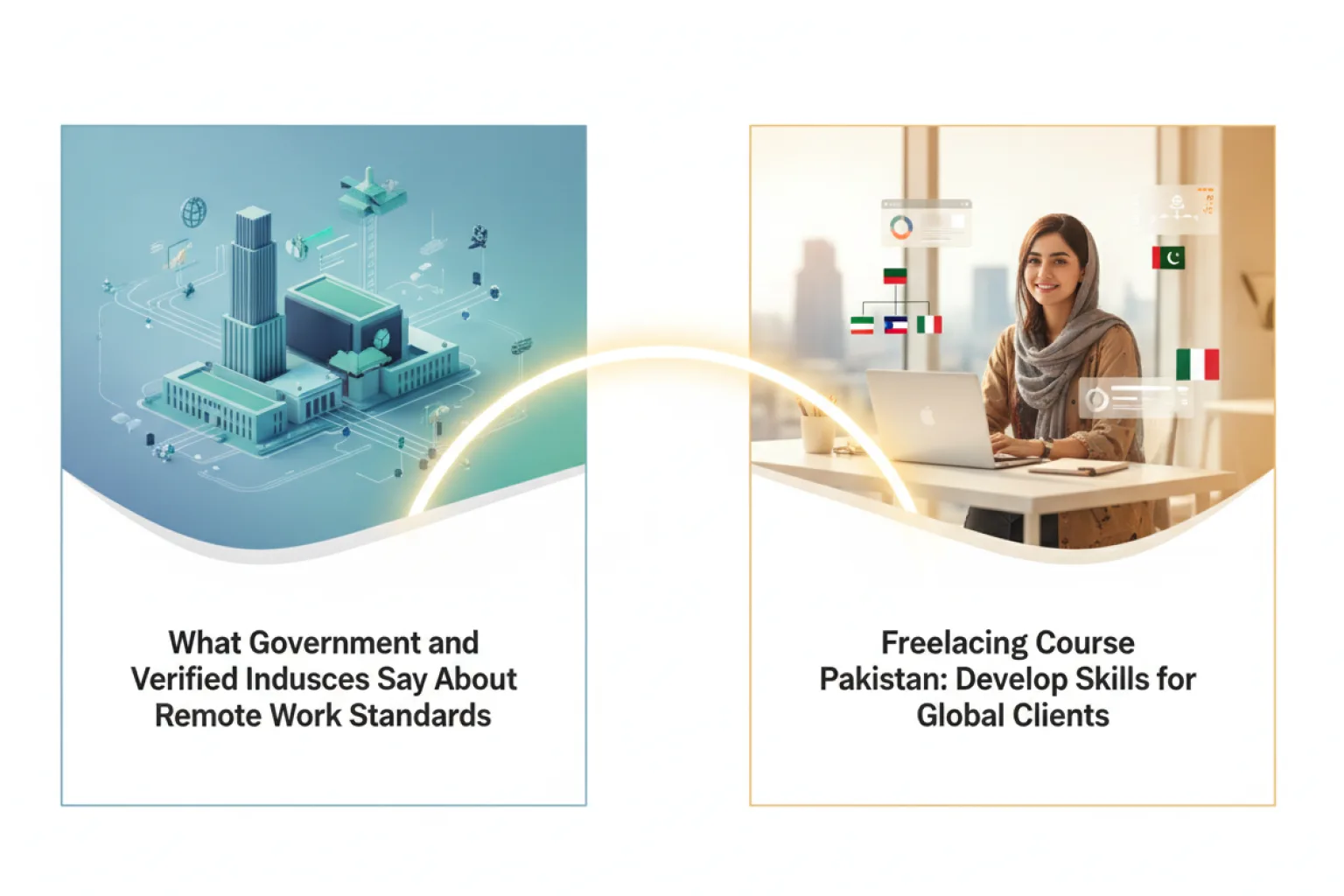
How to Choose the Right Freelancing Course to Launch Your International Career
Most people buy a training program on impulse after seeing an income screenshot on Facebook. That is a mistake. Local marketplaces are flooded with outdated recordings teaching saturated gigs like basic data entry.
Look for three non-negotiables before paying tuition:
- Verified mentor earnings: Your instructor should actively win contracts on Upwork, LinkedIn, or direct outreach—not just profit from teaching.
- A portfolio-driven syllabus: Avoid theory-heavy outlines. If the curriculum does not force you to build three to five live client-ready deliverables, walk away.
- Capstones over quizzes: Look for programs that simulate realistic revisions, contract terms, and client handoffs.
Beyond the curriculum, budget for the baseline tools you need to handle real international work. Ensure you have at least a Core i5 (8th gen or newer) or Ryzen 5 machine, a minimum 20 Mbps fiber connection with a cellular data backup for load shedding, and clean audio gear for Zoom meetings.
Set your expectations around a practical 90-day trajectory rather than overnight success:
| Timeline | Phase Focus | Key Deliverable |
|---|---|---|
| Days 1–30 | Technical Foundation | Replicate industry-standard client briefs |
| Days 31–60 | Portfolio & Positioning | Publish 3 polished, niche case studies |
| Days 61–90 | Client Acquisition | Send 10 targeted, custom proposals weekly |
Start by auditing what you already know. For more info visit our Courses page or contact us on Whatsapp.

Faqs ?
What is a freelancing course in Pakistan?
It is a structured training program designed to teach you a marketable skill alongside the mechanics of selling that service independently. Beyond technical tools, a good freelancing course in Pakistan covers client communication, proposal writing, payment gateways like Payoneer, and platform dynamics on Upwork or Fiverr.
Who can join, and is it suitable for beginners?
Virtually anyone with basic computer literacy and functional English can join. Whether you are an intermediate student, a university graduate, or a professional seeking a side income, beginner-friendly tracks exist for almost every domain.
- Absolute beginners: Start with low-code skills (content writing, basic design, virtual assistance).
- Intermediate learners: Level up into specialized services (SEO audits, performance marketing).
- Technical graduates: Focus on high-barrier niches (full-stack development, cloud setup).
What skills are taught, and how long does it take?
Timelines vary based on technical depth. Beware of bootcamps promising overnight mastery; real execution takes time.
| Skill Track | Typical Course Length | Realistic Time to First Order |
|---|---|---|
| Virtual Assistance & Data Entry | 4 to 6 weeks | 1 to 2 months |
| Content Writing & SEO | 8 to 10 weeks | 2 to 3 months |
| Web Development / Video Editing | 12 to 16 weeks | 3 to 6 months |
Can I earn money immediately after completing the course?
Earning is never guaranteed upon receiving a certificate. Completing a course simply gives you the baseline tools. Your actual revenue depends on your portfolio, how tailored your pitch is, and your persistence. In practice, Pakistani freelancers who land sustainable foreign contracts spend weeks refining sample work and handling rejection before securing their first paying gig.

Conclusion
Enrolling in a freelancing course in Pakistan will not guarantee an income on Upwork or Fiverr by next month. Too many local institutes sell the dream of quick foreign currency without mentioning the grind behind client retention.
Your real challenge begins after the lectures end. Global buyers do not care about your certificates; they care about asynchronous communication, clear deadlines, and ownership of edge cases.
Before committing your savings to any program, weigh what you actually need against what most academies pitch:
| What Most Institutes Promise | What Global Clients Actually Buy |
|---|---|
| Guaranteed platform earnings | Deep domain competence in one niche |
| Template bid proposals | Context-aware Loom audits and tailored pitches |
| Broad overviews of five skills | Proven proof-of-work (GitHub, live Figma, case studies) |
You can learn platform algorithms from YouTube in an afternoon. Use structured training strictly for high-friction barriers:
- Client qualification: Spotting low-budget micromanagers before you submit a proposal.
- Contextual pitching: Writing three-sentence outreach messages that solve a specific bottleneck instead of pasting generic cover letters.
- Fulfillment workflows: Running projects via Trello or Slack so clients never have to chase you for updates across time zones.
Pick a mentor who actively freelances today, build three unapologetically good portfolio samples, and treat your initial outreach as market research. The platform accounts are just plumbing—your underlying craft is what keeps the contract running.

