

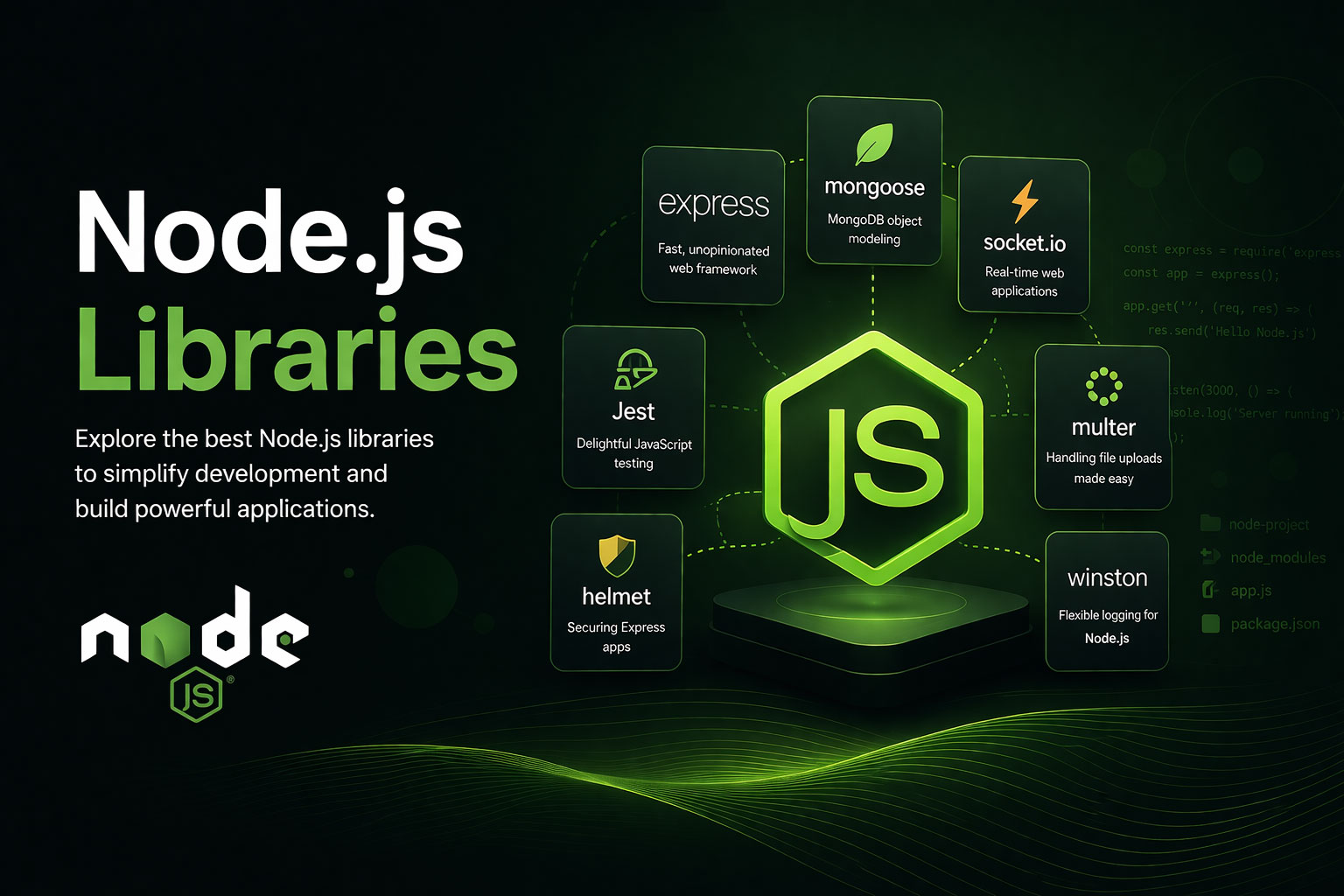
Node.js Libraries That Will Simplify Your Backend Workflow
Node.js libraries are the silent powerhouses behind today’s most scalable and high-performing applications. Because the JavaScript ecosystem moves at an incredible speed, staying updated on these tools is no longer optional for developers who want to remain competitive. Consequently, choosing the right Node.js libraries can mean the difference between a project that launches seamlessly and one that struggles with technical debt.
To begin with, these pre-written code modules allow you to skip the tedious process of building basic functionalities from scratch. For instance, whether you are handling complex API integrations or managing real-time database connections, there is likely a library designed specifically for your needs. Furthermore, using established Node.js libraries ensures that your application benefits from community-vetted security patches and performance optimizations.
In addition to saving time, these tools provide a standardized structure that makes collaboration much easier for engineering teams. However, you must remain selective. While the NPM registry offers millions of options, focusing on the most robust Node.js libraries will guarantee that your backend remains both flexible and maintainable. Therefore, as we dive into this guide, we will explore the essential packages that are currently defining the industry standards for 2026. Ultimately, mastering these Node.js libraries will empower you to build faster, smarter, and more secure digital solutions.
Categorizing the Ecosystem for Efficiency
To begin with, understanding the landscape of Node.js libraries requires a look at how they are categorized. The beauty of this environment lies in its modularity. Instead of a monolithic framework that dictates every move, developers can hand-pick specific modules for specific tasks. For instance, you might use one library for your web server, another for database abstraction, and a third for security.
Consequently, this “plug-and-play” nature allows for a lean development process. However, the sheer volume of choices can be overwhelming. Therefore, it is helpful to divide these tools into core functional areas: web frameworks, database drivers, utility sets, and security middleware. By organizing your stack this way, you ensure that every part of your application is optimized for its particular role.
The Dominance of Web Frameworks
When we discuss the most influential Node.js libraries, web frameworks often lead the conversation. These are the foundational structures that handle HTTP requests and responses. Express.js has long been the industry standard due to its minimalist approach and massive community support. It provides a thin layer of fundamental web application features without obscuring the features of the underlying platform.
On the other hand, newer frameworks like Fastify and NestJS are gaining significant traction in 2026. Fastify, as its name suggests, is focused on providing the lowest overhead possible, making it ideal for microservices where every millisecond counts. Meanwhile, NestJS offers a more disciplined, enterprise-level architecture. It uses TypeScript by default and draws inspiration from Angular, which makes it a favorite for large-scale teams who need a strict structure to prevent “spaghetti code.”
Mastering Data Persistence and ORMs
Another critical area involves how an application interacts with its data. Directly writing raw SQL or NoSQL queries can be prone to errors and security risks. To solve this, developers rely on Object-Relational Mapping (ORM) or Object-Document Mapping (ODM) tools. Mongoose remains the go-to choice for those working with MongoDB, providing a straightforward, schema-based solution to model application data.
Furthermore, for relational databases like PostgreSQL or MySQL, Prisma has revolutionized the experience. It acts as a next-generation ORM that prioritizes type safety. Because it generates a client tailored specifically to your database schema, it significantly reduces runtime errors. By using these types of Node.js libraries, you can manage complex data relationships with much higher confidence and speed.
Enhancing Performance with Utility Modules
Beyond the heavy hitters, there is a vast array of utility modules that handle specific, repetitive tasks. For example, Lodash remains a staple for manipulating arrays, strings, and objects. Even as modern JavaScript (ES6+) incorporates many of these features natively, Lodash often provides more performant or convenient alternatives for complex operations.
In addition to data manipulation, managing asynchronous flows is a common challenge. While native Promises and Async/Await are powerful, libraries like RxJS allow for more advanced reactive programming patterns. This is particularly useful in real-time applications where you are dealing with constant streams of data, such as live chat systems or financial tickers. By integrating these utilities, you ensure that your code remains clean and your logic stays manageable.
Security and Authentication Essentials
In today’s digital climate, security cannot be an afterthought. Therefore, integrating dedicated security middleware is a non-negotiable step in your development workflow. Passport.js has historically been the primary choice for authentication, offering “strategies” that allow users to log in via Google, GitHub, or traditional email/password setups.
Moreover, protecting your app from common vulnerabilities like Cross-Site Scripting (XSS) or header injections is vital. Helmet.js is a small but powerful tool that sets various HTTP headers to secure your Express apps. Additionally, for handling JSON Web Tokens (JWT), the jsonwebtoken package provides the necessary tools to sign and verify tokens securely. By prioritizing these Node.js libraries, you build a perimeter of defense that protects both your business logic and your users’ sensitive data.
Real-Time Communication and WebSockets
As we move further into 2026, the demand for real-time interactivity has skyrocketed. Whether it’s collaborative document editing or live gaming, users expect instant feedback. Socket.io is the definitive leader in this space. It enables bi-directional, event-based communication between the browser and the server.
What makes it stand out is its reliability; if a WebSocket connection fails, it automatically falls back to long-polling, ensuring the user stays connected. Furthermore, for those who need even higher performance with less overhead, ws is a “no-frills” WebSocket implementation that is incredibly fast. Choosing between these depends entirely on whether you need the extra features of Socket.io or the raw speed of a lite implementation.
Testing and Quality Assurance Tools
Ultimately, no piece of software is complete without a rigorous testing phase. Reliable Node.js libraries for testing, such as Jest or Mocha, allow developers to write unit tests and integration tests that run automatically. Jest, in particular, has become a favorite because it requires zero configuration for most projects and includes built-in mocking and coverage reports.
To add to this, Supertest is frequently used alongside these frameworks to test HTTP endpoints. It allows you to simulate requests to your server and assert that the responses are correct. By maintaining a high level of test coverage, you ensure that new updates don’t break existing functionality, which is essential for the long-term health of any professional application.
Managing Logs and Monitoring
Once an application is live, the focus shifts to observability. If an error occurs in production, you need to know exactly what happened and why. Winston and Bunyan are two of the most popular logging libraries that provide structured, searchable logs. Unlike a simple console.log, these tools allow you to pipe logs to external files or cloud services like Datadog or Loggly.
Furthermore, performance monitoring tools like PM2 serve a dual purpose. They act as process managers that keep your application alive (restarting it if it crashes) and provide real-time metrics on CPU and memory usage. Consequently, combining a robust logging library with a process manager creates a resilient environment where issues can be identified and resolved before they impact the end-user.
Validation and Schema Enforcement
Handling user input is one of the most dangerous parts of backend development. If you don’t validate the data coming in, your system becomes vulnerable to crashes or injections. Libraries like Joi and Zod have become essential for defining schemas that user input must follow.
Zod, in particular, has seen a massive rise in popularity due to its “TypeScript-first” approach. It allows you to define a schema once and automatically infer the TypeScript types from it. This eliminates the need to keep your types and your validation logic in sync manually. By implementing these checks at the entry point of your APIs, you create a robust “gatekeeper” that ensures only clean, expected data enters your application logic.
Image and File Processing
Many modern applications require the ability to handle file uploads, whether they are profile pictures or PDF reports. Sharp is a high-performance image processing library that can resize, crop, and convert images at incredible speeds. It is significantly faster than older alternatives because it uses the libvips library under the hood.
Additionally, for handling the actual “multipart/form-data” in file uploads, Multer is the standard middleware used with Express. It makes the process of saving files to a local disk or cloud storage like AWS S3 incredibly simple. Together, these Node.js libraries handle the heavy lifting of media management, allowing you to focus on the unique features of your project.
Frequently Asked Questions
1. How do I choose the best Node.js libraries for my project? When selecting a library, you should prioritize community support, update frequency, and documentation quality. Check the NPM download stats and the GitHub “Issues” tab to see if the maintainers are active. Choosing a well-maintained library ensures your project remains secure and compatible with future Node.js versions.
2. Can using too many Node.js libraries slow down my application? Yes, “dependency bloat” is a real concern. Each library adds to your project’s size and can potentially introduce security vulnerabilities or performance bottlenecks. It is best to use libraries for complex tasks (like database ORMs or image processing) and rely on native JavaScript for simpler logic.
3. Are Node.js libraries safe to use in enterprise environments? Most popular Node.js libraries are safe, but you should always use tools like npm audit or Snyk to scan for known vulnerabilities. For enterprise-grade applications, sticking to industry-standard libraries with large corporate backing or massive community adoption is the safest route to ensure long-term stability.
Conclusion
In conclusion, the strategic implementation of Node.js libraries is the cornerstone of efficient, modern backend engineering. From the foundational power of web frameworks like Express and NestJS to the specialized capabilities of Sharp for image processing and Socket.io for real-time data, these tools allow developers to solve complex problems with minimal friction. However, the key to success lies in balance. By focusing on high-quality, community-vetted packages and avoiding unnecessary dependencies, you can build applications that are not only fast and functional but also secure and easy to maintain. As the ecosystem continues to evolve through 2026, mastering these essential Node.js libraries will remain a vital skill for anyone looking to excel in the world of digital marketing and web development.
If you want to get Our Services, visit our Contact Us page or message us directly on WhatsApp.
Because we believe in continuous growth, we have curated a selection of posts to help you master the digital world. Furthermore, visiting our Blog Page regularly will keep you updated on the latest industry shifts.


