

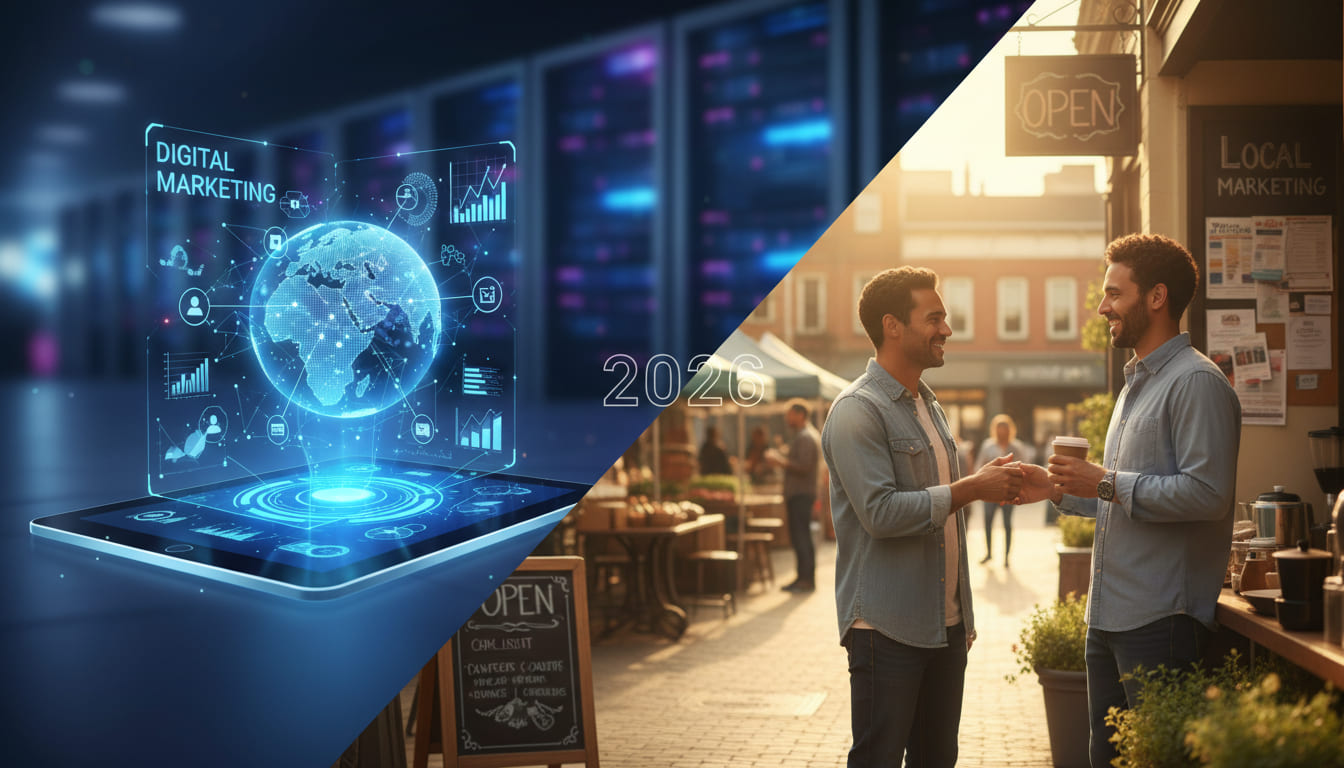
What is Digital Marketing?
By 2026, Digital Marketing has evolved into an umbrella term for any promotional activity conducted via electronic devices and the internet, specifically targeting a broad or non-geographically restricted audience. It encompasses a vast ecosystem including Search Engine Optimization (SEO), programmatic advertising, social media commerce, influencer partnerships, and AI-driven email automation.
The primary characteristic of digital marketing in the current era is its reliance on “Big Data” and predictive analytics. Brands no longer just “post and pray”; they use sophisticated algorithms to identify consumer behavior patterns across the globe. This allows a small boutique in Lisbon to sell handmade shoes to a customer in Tokyo with surgical precision. Digital marketing is typically used by businesses that are “location independent,” such as software companies, digital creators, and large-scale retailers. The primary benefits include massive scalability, the ability to pivot strategies based on real-time data, and the opportunity to build a community that transcends physical borders. It is the ultimate tool for those looking to achieve “viral” growth and establish a dominant market share in a specific industry niche.
What is Local Marketing?
Local Marketing, often referred to as neighborhood marketing or location-based marketing, focuses on targeting audiences within a specific town, city, or radius of a business’s physical location. In 2026, this has moved far beyond simple flyers and billboards. It now involves hyper-local SEO, Google Business Profile (GBP) optimization for AR-maps, community-based social media groups, and proximity-based mobile notifications (geofencing).
The hallmark of local marketing is the “human element.” It leverages the trust and convenience that comes with physical proximity. Who typically uses it? Doctors, plumbers, local cafes, boutique fitness studios, and regional franchises. The primary benefit is a significantly higher conversion rate; when someone searches for “emergency plumber near me,” the intent to purchase is immediate and high. Local marketing focuses on building a reputation within a community, fostering word-of-mouth, and ensuring that when a local resident thinks of a specific service, your name is the first they see on their map or smart glasses. It is less about “reach” and more about “relevance” and “reliability” within a defined geographic territory.
Key Differences Explained
1. Audience Scope & Targeting 🎯
Digital Marketing: The scope is virtually limitless. In 2026, digital marketing tools allow for “interest-based” targeting rather than “location-based.” You are looking for people who share a specific pain point or hobby, regardless of where they live. This requires a deep understanding of psychographics and digital behavior.
✅ Infinite scaling potential
✅ Access to niche global markets
❌ High competition for keywords and attention
Local Marketing: The scope is intentionally narrow. You are targeting “intent-based” users within a 5-to-20-mile radius. In 2026, this includes optimizing for voice search and smart-home assistants that prioritize local providers.
✅ Lower competition (only competing with local rivals)
✅ Higher intent and faster conversion
❌ Limited by the total population of the area Winner: Tie – It depends on whether you need volume (Digital) or immediate foot traffic (Local).
2. Cost & Budgeting 💰
Digital Marketing: Digital marketing often operates on a “pay-to-play” model with global bidding. To rank for a keyword like “best skincare,” you are competing with multi-billion dollar corporations. While you can start small, scaling requires a significant investment in content production and ad spend. Local Marketing: Generally more cost-effective. Local SEO and community sponsorships often yield a higher ROI per dollar spent because you are targeting a smaller, more relevant pool of people. Ad costs for local keywords are typically lower than broad industry terms. Winner: Local Marketing – For small to medium businesses, local marketing offers a much more sustainable entry point and higher immediate ROI.
3. Technology & Tools ⏱️
Digital Marketing: Relies heavily on complex tech stacks: CRM systems, AI content generators, multi-channel attribution software, and global CDN networks. It requires a high level of technical expertise to manage effectively. Local Marketing: Focuses on “local-first” tools like Google Business Profile, Apple Maps, local directory citations, and community-based platforms like Nextdoor. The tech is simpler but requires consistent management of reviews and local reputation. Winner: Digital Marketing – If you want cutting-edge innovation and data-driven insights, digital marketing tools are far more advanced in 2026.
Pros and Cons Summary
Digital Marketing
Pros:
✅ Reach a global audience 24/7.
✅ Highly measurable with real-time analytics.
✅ Easier to automate using AI agents.
✅ Can build a massive brand authority.
✅ Diverse range of platforms (Video, Text, Social).
Cons:
❌ Extremely high competition levels.
❌ Requires constant updates to stay ahead of algorithm shifts.
❌ High cost of acquisition for broad markets.
Local Marketing
Pros:
✅ Builds strong community trust and loyalty.
✅ Higher conversion rates due to proximity.
✅ Lower advertising costs (lower CPC).
✅ Physical presence acts as a permanent advertisement.
✅ Easier to dominate a specific geographic niche.
Cons:
❌ Growth is capped by local population size.
❌ Vulnerable to local economic downturns.
❌ Harder to scale to multiple cities without high overhead.
Which Should You Choose?
Choose Digital Marketing if:
✅ You sell a digital product (SaaS, E-books, Courses).
✅ You have an e-commerce store with national/international shipping.
✅ You want to become a thought leader in a specific global niche.
✅ You have the budget to sustain long-term SEO and PPC campaigns.
Choose Local Marketing if:
✅ You have a physical location that customers must visit.
✅ You provide “at-home” services (HVAC, Cleaning, Landscaping).
✅ Your business relies heavily on local reputation and reviews.
✅ You want to see a faster return on investment with a smaller budget.
Try Both if:
✅ You are a local business looking to expand into e-commerce.
✅ You have multiple locations across different states or countries.
✅ You want to use digital brand authority to drive local foot traffic.
Real User Experiences
Digital Marketing Success Story:
“By shifting our focus from local boutiques to a global Shopify store backed by AI-driven Instagram ads, we grew our revenue by 400% in 18 months. We no longer care about foot traffic; we care about our global conversion rate.” — Sarah J., Founder of ‘Eco-Wear Threads’
Local Marketing Success Story:
“We stopped trying to rank for ‘best dental tips’ globally and focused entirely on ’emergency dentist in North Austin.’ Our booking rate tripled, and our ad spend dropped by half. In 2026, being the big fish in a small pond is much more profitable.” — Dr. Marcus L., SmileBright Dental
Can You Do Both?
Absolutely. In 2026, the most successful brands use a “Glocal” strategy. This means having a broad digital presence to build brand authority while using hyper-local tactics to win specific markets. For example, a national gym chain might use digital marketing for its fitness app but local marketing to fill its individual branches.
Benefits of combining: • Diversified lead generation sources. • Higher brand trust (seeing a brand online and then seeing their shop in person). • Protection against algorithm or local market shifts.
How to combine them:
- Local Content, Global Reach: Create high-quality videos about your local community that have the potential to go viral globally.
- Geofenced Digital Ads: Run broad digital ads but only show them to people within 5 miles of your store.
- Local SEO for Digital Products: If you sell a service, create “City-specific” landing pages to capture local search intent.
Expert Recommendations
For Beginners: Start with Local Marketing. It is easier to see what is working, the costs are lower, and you can build a foundation of reviews and trust that will support a broader digital push later.
For Intermediate Users: Focus on Digital Marketing for a Niche. Once you have a stable local base, use digital tactics to reach a specific audience segment nationally to diversify your income.
For Advanced Users: Implement Omnichannel Integration. Use AI to track a customer’s journey from a global social media ad to a local store visit, ensuring the brand voice is consistent across all touchpoints.
Frequently Asked Questions
Q: Is Digital Marketing better than Local Marketing for a new startup? A: It depends on your product. If you are a service-based startup (like a new agency), Local Marketing is better to get your first 10 clients. If you are a tech startup, Digital Marketing is essential from day one.
Q: Can I switch from Local Marketing to Digital Marketing? A: Yes. Many businesses start local to prove their concept and then “digitize” their offering (e.g., a local yoga studio launching an online subscription app).
Q: Which is more AI-dependent in 2026? A: Digital Marketing relies more on AI for data analysis and content, while Local Marketing uses AI primarily for voice search optimization and managing local reputations.
Q: How long before I see results with Local Marketing? A: You can see results in as little as 30 days if your Google Business Profile is optimized and you run targeted local ads.
Final Verdict
In 2026, the “better” strategy is the one that aligns with your operational capacity. Digital Marketing is a marathon of scale; it requires technical prowess and a willingness to compete on a global stage. It is the engine of the modern “borderless” economy. Local Marketing, conversely, is a sprint of relevance. It is about winning the “here and now” and becoming an indispensable part of a physical community.
My Personal Take: I have seen too many small businesses burn their budgets trying to rank for national keywords when they could have owned their zip code for a fraction of the cost. However, I have also seen local businesses stagnate because they refused to adopt digital tools. The winner in 2026 is the business that acts locally but thinks digitally.
Bottom Line: Start local to build cash flow and trust; go digital to build wealth and scale.
Next Steps
Ready to get started?
If you chose Digital Marketing: → [Guide: Mastering Programmatic Ads in 2026] → [Resource: Top 10 AI SEO Tools for Global Reach]
If you chose Local Marketing: → [Guide: Optimizing for Google AR-Maps] → [Resource: How to Get 100+ Local Reviews in 30 Days]
Conclusion
Whether you choose Digital Marketing or Local Marketing, the most important thing is consistency and data-driven adaptation. Both offer incredible paths to profitability in 2026, and you really can’t go wrong with either if you understand your audience’s intent.
Have you tried Digital Marketing or Local Marketing for your business this year? Which do you prefer? Share your experience in the comments! or visit our service or courses page.
You can also contact us on Whatsapp.


