

Best AI Tools for SEO Content in 2026: A Complete Guide for Writers and Marketers
Choosing the best AI tools for SEO content in 2026 is harder than it looks. Dozens of platforms promise to research keywords, draft articles, and push you to page one in minutes. Meanwhile, Google keeps rewarding content that shows real expertise, original insight, and genuine usefulness, and it keeps acting against pages that are mass-produced to manipulate rankings.
This guide cuts through the noise. You will learn how search has changed, which AI tools help with keyword research, writing, and optimization, how to build a hybrid human and AI workflow, what Google’s guidelines actually say, and how to choose the right stack for your team and budget. We also walk through UDM’s own AI Tools workspace, a collection of 13 focused tools for SEO and content teams.
The short answer: the best AI tools for SEO content are the ones that assist your editors instead of replacing them. They fall into three groups: research tools (keywords, topics, search intent), writing and optimization tools (drafting, on-page scoring, brand voice), and audit and planning tools (site health, traffic, growth roadmaps).
How the Search Landscape in 2026 Changed What We Need from AI SEO Tools
From bulk publishing to semantic depth
For a while the playbook was simple: generate hundreds of articles, target every long-tail keyword, and hope enough of them rank. Google’s spam policies now describe that pattern as scaled content abuse, meaning many pages created mainly to manipulate rankings rather than help people. The policy applies whether the pages are made by AI, by humans, or by a mix of both.
The sites that win today go deeper instead of wider. One page fully answers a question, covers the related entities and sub-topics around it, and adds something competing pages do not.
Entity-based search and generative results
Search engines no longer just match strings of words. They understand entities (brands, products, people, places, concepts) and the relationships between them. On top of that, generative experiences such as Google’s AI Overviews and AI Mode summarize answers directly on the results page. Early discussions called this Search Generative Experience (SGE), and the name stuck in many SEO circles.
For content creators, optimizing for these experiences means:
- Answering the main question clearly near the top of each section.
- Using descriptive headings that match how people actually phrase questions.
- Covering related entities and sub-topics, not just one keyword.
- Backing claims with verifiable facts so your page is worth citing.
What modern AI SEO software must do
Judge any tool against three core capabilities:
- Real-time SERP intent mapping. The tool should show what kinds of pages currently rank (guides, product pages, comparisons, forums) so you match the intent instead of guessing.
- Conversational retrieval. People now search in full sentences and follow-up questions. Good tools surface those questions and sub-queries so your content can answer them in plain language.
- Factual cross-referencing. The tool should help you check claims against sources, or at least make unsupported statements easy to spot.
The new standard for high-ranking content
Pure topical coverage is no longer enough, because every competitor can generate a complete-looking outline in seconds. What separates ranking content now is originality: first-hand testing, proprietary data, expert quotes, original screenshots, and clear opinions. Originality and unique data points outweigh sheer volume.
That is the lens for the rest of this guide. The best AI tools for SEO content speed up research, structure, and editing, while the experience and judgment stay human.
The Best AI Tools for Keyword Research, Topic Clusters, and Search Intent Analysis

Keyword research is where AI delivers the clearest time savings. It can process large sets of queries, group them by meaning, and label their intent far faster than a manual spreadsheet.
Established platforms worth evaluating
- Semrush. A broad SEO suite with keyword research, topic research, competitor analysis, and AI-assisted features in the same workspace. Strong when you want research, tracking, and audits under one login.
- Ahrefs. Known for its large keyword and backlink databases, its Keywords Explorer, and “parent topic” grouping that shows which broader topic a keyword belongs to. Useful for judging whether a keyword can realistically rank.
- MarketMuse. Built around topic modeling and content inventory analysis. It helps you see which topics your site already covers well, where the gaps are, and how deeply competitors treat a subject.
Feature sets change often, so check each vendor’s current plans before you commit.
UDM Keyword Planner
UDM’s Keyword Planner takes six inputs and returns keyword ideas with search demand, competition, intent, CPC ranges, and content opportunities. It suits agencies and bloggers who want a quick first pass before a post, a landing page, or a client plan. Treat it as a starting point and validate priority keywords against Google Search Console and a second data source.
How AI predicts search intent and emerging sub-topics
Language models read queries the way a person does, so they can group “best AI tool for SEO ranking” and “AI tools for content writing” into the same commercial-investigation intent even though the wording differs. They can also suggest follow-up questions and adjacent sub-topics that competitors have not covered yet. This helps you spot opportunities earlier than volume-based metrics alone, because new queries often show little or no recorded volume at first. Treat these suggestions as hypotheses to test, not guarantees.
From broad seed to topic cluster
A topic cluster is a group of interlinked pages that together prove you cover a subject thoroughly. Here is a simple workflow:
- Start with a seed. Example: “AI tools for SEO.”
- Expand it. Pull related keywords, questions, and “people also ask” topics from your research tool.
- Group by intent. Separate informational (what is, how to), commercial (best, vs, review), and transactional queries.
- Choose a pillar. For this seed, the pillar is a guide to the best AI tools for SEO content.
- Assign cluster pages. Examples: AI keyword research tools, AI blog writers, AI website audit tools, and Google’s AI content policy explained.
- Link them deliberately. Each cluster page links up to the pillar, and the pillar links down to each cluster page.
How to choose: data freshness or database size
- Freshness-first tools suit fast-moving niches such as technology, news, and trends, where last quarter’s data is already stale.
- Large-database tools suit stable niches, backlink research, and long-tail discovery, where historical depth matters more.
- Many teams combine both: one big database for research, plus a fresher source such as Search Console for validation.
Top AI Writing and Optimization Platforms for High-Ranking Editorial Content

On-page optimization platforms
- Surfer SEO. Its content editor scores your draft against top-ranking pages and suggests terms, headings, and length targets.
- Frase. Combines research, outline building, and optimization, and is popular for turning SERP analysis into a brief quickly.
- Clearscope. Focuses on term recommendations and readability grades, and is favored by editorial teams that want clean, simple guidance.
Drafting assistants and brand voice
- Jasper. Built for marketing teams, with brand voice and style guide features designed to keep many writers consistent.
- Claude. Teams can load a style guide, tone examples, and audience notes into a custom system prompt or project so drafts start closer to the house voice, which helps on specialized or technical topics. Claude’s enterprise plans add team controls on top.
The test for any drafting assistant is simple: give it two of your best articles and ask for a new draft. If an editor cannot tell it from your normal output after a light edit, the voice setup works.
Live SERP scoring without over-optimization
Scoring engines are guides, not goals. Chasing a perfect score pushes writers to stuff in terms unnaturally. Use the score to find missing sub-topics, then stop when the page reads naturally and answers the question completely. A page that sounds robotic to a person is a risk, however green the score is.
Fact-checking and source attribution
Some platforms now link claims to sources or flag statements to verify. These features help, but no tool removes hallucination risk. In specialized niches such as finance, health, legal, and technical subjects, a subject matter expert should check every statistic, date, and product claim before publishing.
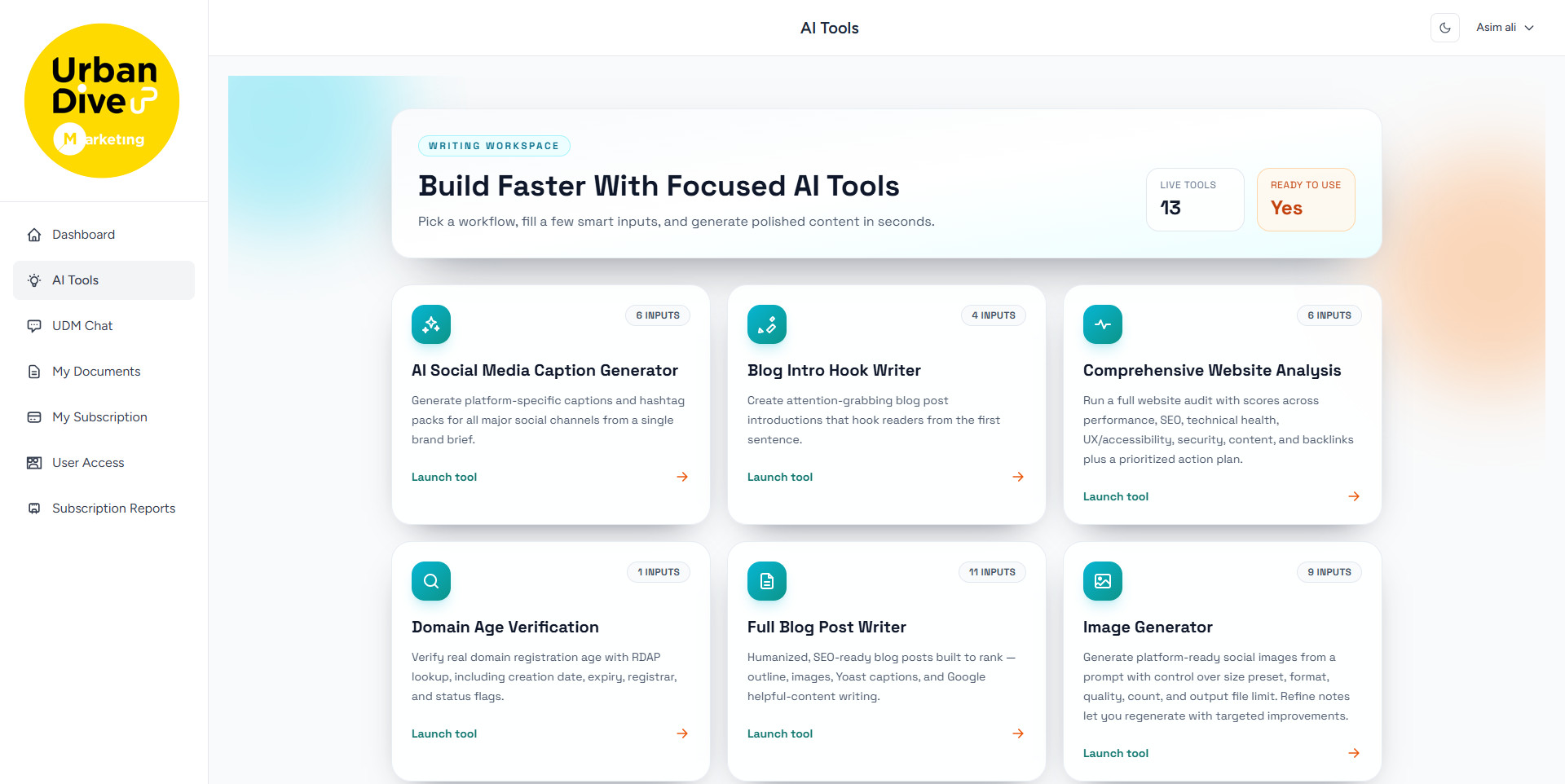
UDM AI Tools: a 13-tool workspace for SEO and content
UDM AI Tools is a “Writing Workspace” inside the UDM dashboard. Each tool asks for a handful of inputs, so you pick a workflow, fill in a few smart details, and generate polished content in seconds. The sidebar also includes a Dashboard, My Documents, and subscription management. The 13 live tools are:
Content writing
Full Blog Post Writer (11 inputs):
humanized, SEO-ready posts with an outline, images, Yoast captions, and Google helpful-content writing.
SEO Blog Title Ideas (3 inputs):
click-worthy, SEO-optimized titles you can copy or send straight into the Full Blog Post Writer.
Blog Intro Hook Writer (4 inputs):
attention-grabbing introductions that hook readers from the first sentence.
AI Social Media Caption Generator (6 inputs):
platform-specific captions and hashtag packs for major social channels from a single brand brief.
Landing Page Maker (15 inputs):
premium niche landing pages with logo upload and automatic or manual brand colors, generating hero, benefits, FAQ, and CTA HTML.
Research and strategy
- Keyword Planner (6 inputs): search demand, competition, intent, CPC ranges, and content opportunities.
- SEO Growth Plan (11 inputs): client-ready multi-month plans with critical fixes, keyword tiers, pages, a blog calendar, and KPIs.
Audits and analysis
- Comprehensive Website Analysis (6 inputs): a full audit with scores across performance, SEO, technical health, UX and accessibility, security, content, and backlinks, plus a prioritized action plan.
- Website Traffic & SEO Analyzer (8 inputs): a Search Console-style SEO and traffic report generated from a domain, covering channels, keyword trends, and backlinks.
- Domain Age Verification (1 input): RDAP lookups showing creation date, expiry, registrar, and status flags.
Creative and assistant tools
- Image Generator (9 inputs): platform-ready social images with control over size preset, format, quality, count, and output file limit, plus refine notes for targeted regeneration.
- Video Generator (9 inputs): social-ready video concepts with scene-by-scene prompts, narration, on-screen text, and production settings.
- UDM Chat: a ChatGPT-style assistant with conversation history, Fast and Smart models, and Save to Documents.
Because one workspace covers research, drafting, audits, and planning, a team can move from keyword to published post without juggling five logins. As with any AI output, review and edit before publishing, and confirm traffic and ranking numbers against your real Search Console and analytics data.
How to Build a Hybrid Human-AI Workflow That Produces Rankable Content
The most reliable approach splits the work: AI handles speed and structure, humans handle experience and judgment. Here is a four-step workflow you can repeat for every post.

Step 1: Use AI for SERP analysis, gap discovery, and outlines
Ask your tool to summarize what the top ten results cover, then list the questions they leave unanswered. Build your outline around those unranked sub-queries. In UDM AI Tools, you can start with the Keyword Planner to choose the target, use SEO Blog Title Ideas to shape the angle, and let the Full Blog Post Writer generate the outline and first draft.
Step 2: Inject human expertise and experience
This step is what makes a post rankable instead of replaceable. Add:
- Proprietary screenshots and results from your own work.
- Original quotes from clients, engineers, or specialists.
- Specific examples, mistakes, and lessons from real projects.
- A clear opinion wherever the evidence supports one.
These additions are the practical side of E-E-A-T (experience, expertise, authoritativeness, trust).
Step 3: Use AI for precision editing and technical SEO
Once the substance is in place, AI is excellent at mechanical work: title and meta description variations, internal linking suggestions, FAQ drafting from real questions, image alt text, and schema markup (JSON-LD). Always validate schema with Google’s Rich Results Test before you publish.
Step 4: Run a manual editorial pass
Read the whole piece aloud and strip out generic phrasing: openers such as “In today’s fast-paced digital world,” filler transitions, vague claims like “many experts agree,” heavy passive voice, and repetitive sentence patterns. Check every fact, link, and number. Make sure the introduction answers the query within the first few lines.
Real-World Examples: What Successful AI-Assisted SEO Content Looks Like
The scenarios below are illustrative. They are built from patterns common in SEO work, not data from a single named client.
Example 1: An AI-assisted topic cluster for a B2B SaaS company
Imagine a B2B software company that wants to rank for integration-related queries. The marketing team uses AI to analyze the SERP, map sub-topics, and draft cluster outlines. Instead of publishing those drafts, they send each outline to an engineer who adds real configuration steps, screenshots, edge cases, and common errors. The result is a set of pages that target the same keywords as competitors but contain details only a practitioner would know. Teams that work this way judge success by qualified organic traffic and demo requests, not by page count.
Example 2: Fully automated versus hybrid
Take a single query such as “best AI tools for SEO content.”
- The fully automated post: a generic introduction, a list of tools with feature descriptions paraphrased from vendor pages, no testing, no opinion, and no sources. It offers nothing a reader could not get from ten other pages.
- The hybrid post: the same structure and AI-assisted research, but with tested workflows, screenshots, clear pros and cons, a decision framework, and sourced claims. It answers the follow-up questions a real reader has.
Example 3: Why the hybrid approach tends to be rewarded
Google says its systems aim to reward helpful, reliable, people-first content regardless of how it was produced. A page that uses AI for schema and structure while the body copy comes from first-hand testing fits that description: the technical layer is clean and the substance is original.
Key takeaways
- Use AI for structure and speed, and people for substance.
- Original experience is the one ingredient competitors cannot copy.
- Optimization scores are a means, not the goal. Watch engagement signals such as scroll depth and time on page in your own analytics as signs that readers are satisfied, even though Google does not publicly confirm them as ranking factors.
Google Search Guidelines, Source-Backed Truths, and Avoiding Algorithmic Penalties
What Google actually says about AI content
Google’s Search Central guidance says using AI is not against its guidelines by itself. Content is judged like any other content: is it helpful, original, and created for people? The risk comes from using generative tools to produce many pages without adding value, which can violate the scaled content abuse policy Google introduced in March 2024.
For the latest wording, go to the primary sources: Google Search Central documentation and blog, and the Search Off the Record podcast where Google’s search team discusses quality and spam. Reading them directly beats relying on second-hand summaries.
Penalty for AI, or penalty for unhelpful content?
In practice, ranking and spam systems are not hunting for a label that says “written by AI.” They react to patterns: thin, derivative, repetitive, or manipulative pages. Human-written spam gets the same treatment as AI-written spam, and helpful AI-assisted content is treated like any other helpful content.
Quality benchmarks to follow
- Verify every data claim before you publish it.
- Cite primary sources, such as official documentation and peer-reviewed studies, for research-based statements.
- Avoid automated link-building schemes, which fall under Google’s link spam policies.
- Do not generate near-duplicate pages at scale, such as templated city pages with swapped place names.
- Show clear authorship and keep publish and update dates accurate.
Why unedited AI drafts hurt your site
Publishing raw drafts tends to produce generic, error-prone pages that add nothing new. Across a whole site, that weakens the trust signals readers and quality systems look for, and it increases your exposure when Google rolls out core quality and spam updates. E-E-A-T is best understood as a framework Google’s quality raters use to evaluate trustworthiness, not a single score you can optimize. Editing is cheap insurance.
How to Choose the Right AI SEO Tech Stack for Your Team and Budget
Match the stack to your team
- Solo freelance writers: one research tool or a lean all-in-one workspace, one general-purpose LLM with a saved style prompt, and a free Google Search Console account. Keep costs low.
- High-velocity affiliate publishers: strong SERP scoring, brief generation, and fact-checking matter most, along with a firm quality gate so volume never turns into scaled low-value output.
- In-house brand teams: prioritize brand voice controls, collaboration, approvals, and integrations with your CMS and analytics.
- Agencies: multi-client workflows, audits, reporting, and growth plans. A workspace like UDM AI Tools, with its website analysis, traffic analyzer, and SEO Growth Plan, fits client-facing deliverables.
Cost-to-value: general LLMs or specialized software?
General-purpose LLMs with a carefully written system prompt are inexpensive and flexible for drafting, outlining, and editing. Specialized, seat-based SEO platforms earn their price when you need live SERP data, large keyword databases, competitor tracking, or collaboration features a chatbot cannot provide. A common and cost-effective pattern is one specialized data tool plus one general LLM.
The 4-point audit before you buy
- API and integrations: does it connect with your CMS, analytics, and reporting tools?
- SERP scrape limits: are there caps on reports, keywords, or live SERP lookups that your volume would hit?
- UX ease: can a new writer use it productively within a day?
- Export flexibility: can you export briefs, drafts, and data in formats you can reuse, such as Docs, HTML, or CSV?
Your next steps
- List every SEO and AI subscription you pay for today.
- Note what each one is actually used for each month.
- Cancel overlapping tools.
- Fill any real gap (research, drafting, or audits) with one tool, not three.
- Write a short editorial checklist (fact-check, expert input, human edit) that every AI-assisted piece must pass before it goes live.
Frequently Asked Questions
What are the best AI tools for SEO content in 2026?
It depends on the job. For keyword research, consider Semrush, Ahrefs, MarketMuse, or UDM’s Keyword Planner. And for on-page optimization, look at Surfer SEO, Frase, and Clearscope. For drafting, consider Jasper, Claude, or UDM’s Full Blog Post Writer, and audits and planning, UDM’s Comprehensive Website Analysis and SEO Growth Plan are built for the task.
Does Google penalize AI-generated content?
Not simply because AI was used. Google evaluates whether content is helpful and original. Mass-producing low-value pages to manipulate rankings can violate its scaled content abuse policy, however the pages are produced.
Can AI tools write a blog post that ranks?
They can produce a strong foundation, but posts rank when people add experience, accurate facts, and a clear point of view. Treat AI as a fast research assistant and first-draft writer.
What is the best AI tool for keyword research?
There is no single winner. Large-database tools such as Ahrefs and Semrush suit broad research, while MarketMuse suits topic-level planning. UDM’s Keyword Planner is a quick starting point for demand, competition, intent, and CPC ranges.
How do I stop AI content from sounding generic?
Add first-hand examples, original data, and expert quotes. Give your tool a style guide, then run a manual edit that removes clichés, passive voice, and repetitive structures.
Are free AI tools enough for SEO content?
For a solo writer, a general-purpose LLM plus Google Search Console can go a long way. Paid tools start to pay off when you need live SERP data, large keyword databases, or team workflows.
Conclusion
The best AI tools for SEO content in 2026 make your team faster without making your content forgettable. Use research tools to find the right topics and intent, writing and optimization tools to draft and polish, and audit tools to find what is holding your site back. Then add the one thing no tool can supply: real experience.
If you want to run that whole workflow in one place, explore UDM AI Tools. From the Keyword Planner and SEO Blog Title Ideas to the Full Blog Post Writer, Comprehensive Website Analysis, and SEO Growth Plan, every step from keyword to published post is covered. Want help turning it into a strategy? Talk to the UDM Creative team about SEO, content, and digital marketing for your business.
Have any Question? contact us on whatsapp or visit our contact details.

